Nelson Mandela did not simply end apartheid; he showed the world that reconciliation is possible even after the deepest wounds. When he walked out of prison after 27 years, he chose not vengeance but forgiveness, not division but dialogue. That choice to build cooperation over conflict, to protect human dignity over power is the moral foundation on which Global Peace stands.
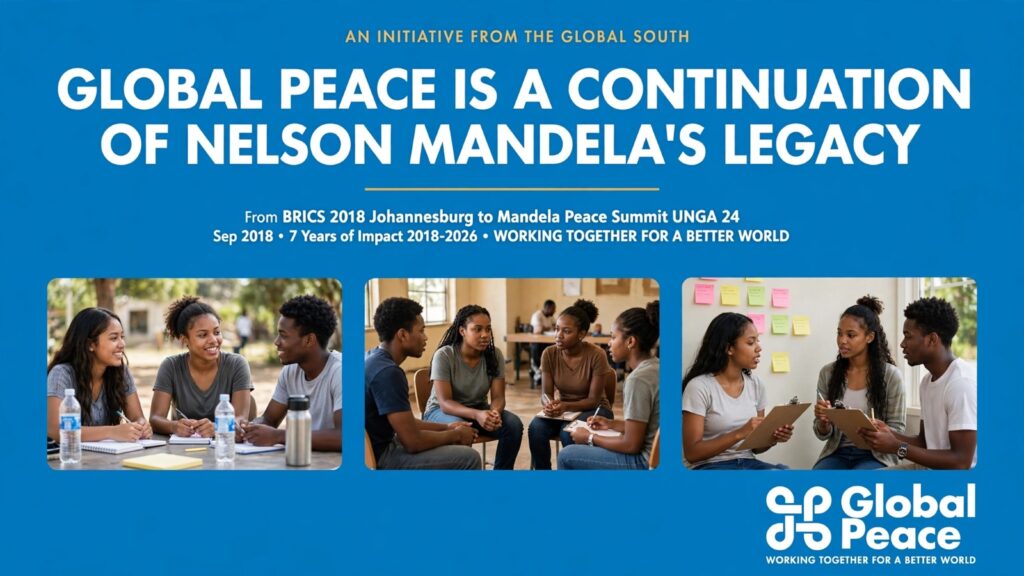
Global Peace is a direct continuation of Nelson Mandela’s legacy. It was not created in abstraction, but in action, at historic moments that honour his life and values.
1. The Genesis, From BRICS 2018 to Mandela Centenary.
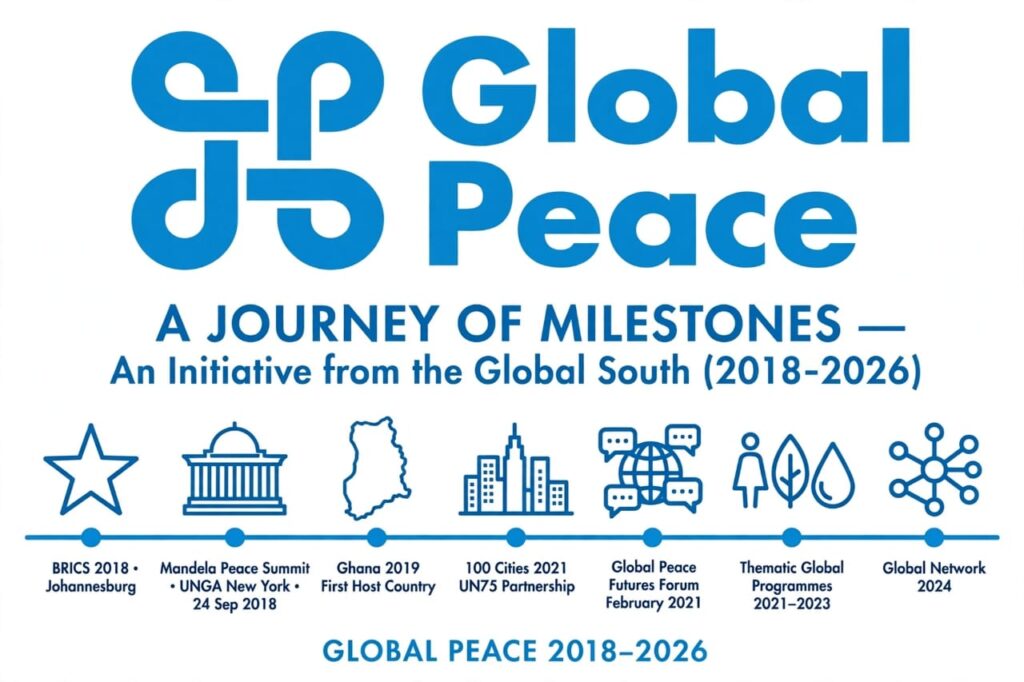
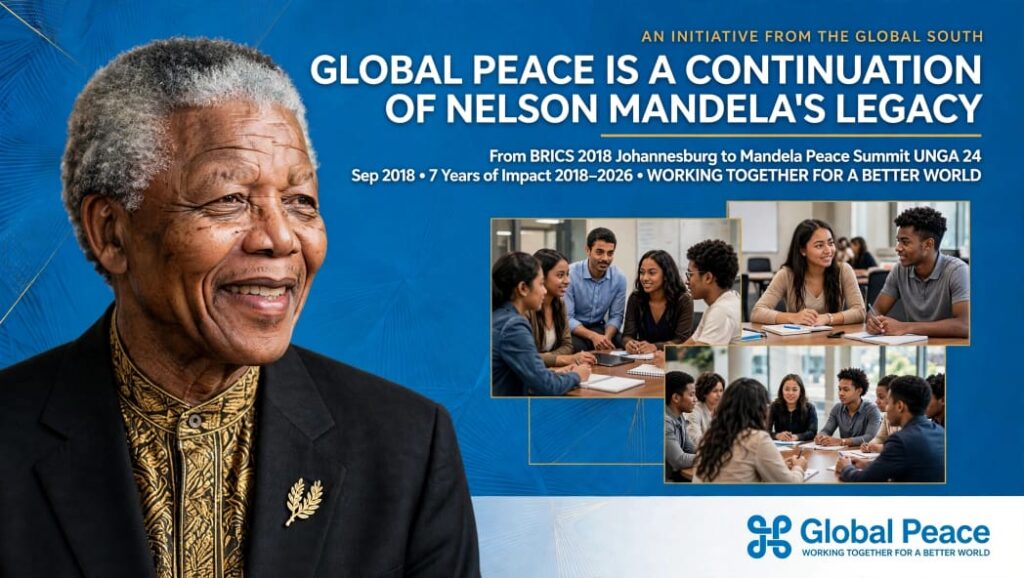
On 27 July 2018, during the BRICS Summit in Johannesburg, President Cyril Ramaphosa hosted 22 Heads of State, Heads of Government and global leaders at a luncheon representing more than half the world’s population. In that room, the idea of Global Peace as a Global South-led initiative for dialogue and delivery was born; just days after the world marked Mandela’s 100th birthday on 18 July.
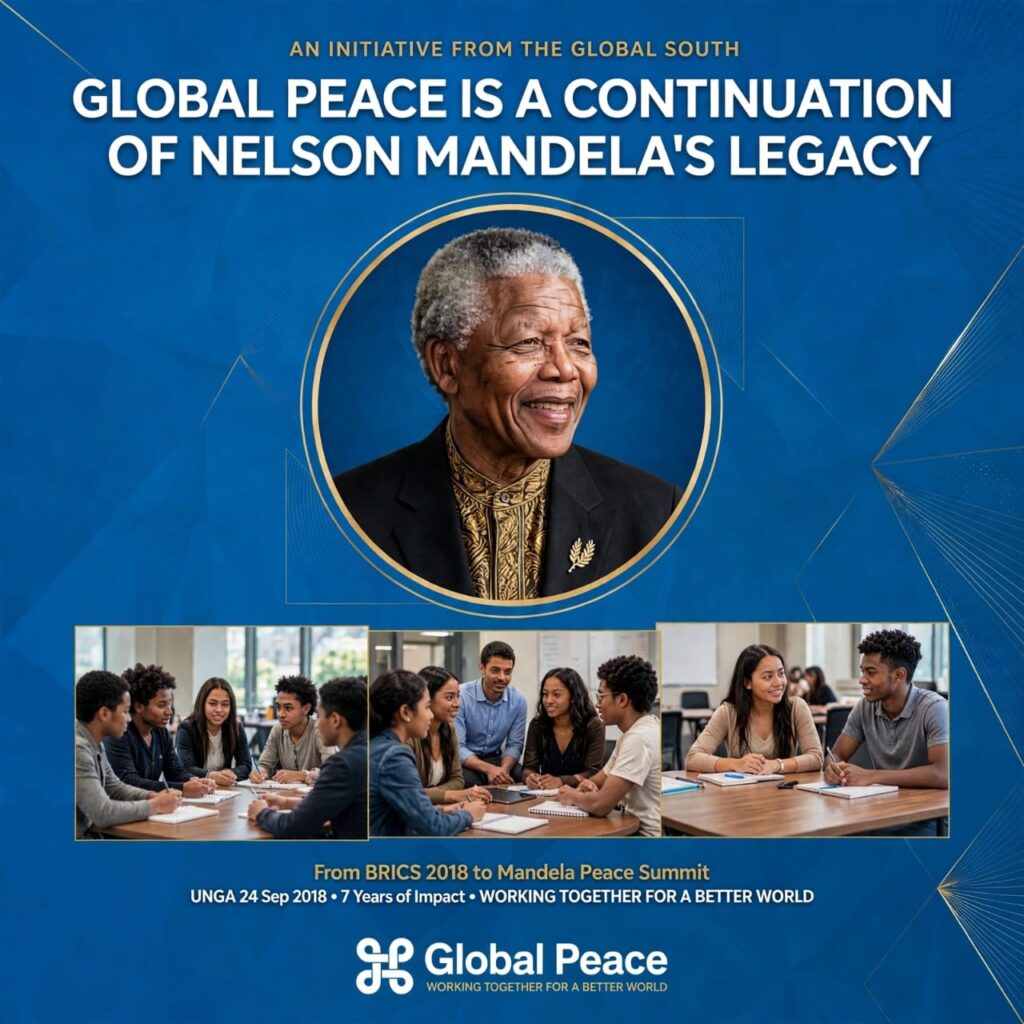
Then, on 24 September 2018, at the United Nations General Assembly in New York, world leaders gathered for the Nelson Mandela Peace Summit; a once-in-a-century high-level meeting convened to honour the centenary of Mandela’s birth. Chaired by Mrs Graça Machel, Mandela’s wife, global peace advocate and stateswoman, the Summit reaffirmed the world’s commitment to Mandela’s values: peace, dialogue, reconciliation and multilateralism. It was there, on that historic stage at the UN, that Global Peace was formally introduced to the world by Mrs Machel as a vehicle to carry Mandela’s legacy forward not as memory, but as movement.
Mandela had always believed peace must be practiced, not just preached. Global Peace took that belief literally.
2. The Philosophy, Ubuntu, Mpatapo and Working Together.
At the heart of Mandela’s worldview was Ubuntu; “I am because we are.” He understood that our humanity is bound together, that no one is free until all are free. Global Peace translates Ubuntu into action through its motto: “WORKING TOGETHER FOR A BETTER WORLD.”
This motto operates on four foundational principles that mirror Mandela’s life’s work:
1. In building cooperation, tolerance and shared values, Mandela united a divided South Africa through truth and reconciliation. Global Peace does the same through Inter-Generational Dialogues (IGDs), where elders and youth, leaders and citizens, listen to each other across cultures, faiths and generations.
2. In building Inclusive Economies, Mandela fought for economic justice as inseparable from political freedom. Global Peace promotes inclusive economies that empower women and youth, supporting entrepreneurs and creating opportunities that ensure dignity for all because poverty is itself a form of violence.
3. In protecting and sustaining our Environment, Mandela reminded us we are stewards of the earth for future generations. Global Peace mobilises youth to plant trees, clean oceans and advance renewable energy, linking climate action to peace.
4. In sharing Knowledge for Human Progress, Mandela called education “the most powerful weapon which you can use to change the world.” Global Peace builds platforms where knowledge: indigenous, academic, technological is shared freely to advance humanity.
Our symbol, the Adinkra Mpatapo the knot of pacification and reconciliation encapsulates Mandela’s method: binding what has been torn apart, reconciling what has been divided.
3. The Journey, From Dialogue to Delivery (2018-2026).
Mandela’s legacy was never about speeches; it was about delivery. Global Peace has followed that path for seven years of impact:
In 2019, Ghana became our first host country, where President Nana Akufo-Addo and Mrs Graça Machel jointly launched the first Inter-Generational Dialogue in Accra with over 500 delegates. Ghana, the first sub-Saharan African country to gain independence, embodied Pan-African leadership for peace, a value Mandela championed.
In February 2021, despite COVID-19, Global Peace partnered with the United Nations for the UN75 Global Campaign and delivered dialogue in 100 cities across 100 countries proving that even in isolation, solidarity is possible. That same month, we convened the Global Peace Futures Forum, where youth asked: “Who is the WE?” Challenging the world to redefine inclusion. The dialogue featured H.E. Amina J. Mohammed, UN Deputy Secretary-General, and Mrs Machel, bridging UN leadership with grassroots voices.
Between 2021 and 2023, we expanded into Thematic Global Programmes: Women Peace and Security, Climate Summit, Children’s Forum, World Water Forum delivering over 60 programmes and honouring 350 Global Peace Citizens who embody Mandela’s service ethic daily.
By 2024, we institutionalised this work through a Global Network of Country Coordinators in countries including Albania, Australia, Brazil, Cameroon, Colombia, Ghana, Mexico and many others, with the Secretariat at ACCORD HOUSE in Durban; the city that shaped Mandela’s early activism and where South Africa’s premier conflict resolution institution, ACCORD, is based.
4. The Continuation Of Living Values, Not Just Remembering Them.
To say Global Peace is a continuation of Mandela’s legacy is to say three things:
First, it continues his method of dialogue over diktat, reconciliation over revenge, collective leadership over personal power. Our IGDs model the Conversations Mandela had patient, respectful, and transformative.
Second, it continues Mandela’s legacy of constituency that puts youth, women and the marginalised at the centre. So does Global Peace. When a young woman in Cameroon leads a peace circle, when a child in Brazil plants a tree for climate justice, Mandela’s belief that ordinary people can do extraordinary things lives on.
Third, it continues his horizon of which Mandela never saw South Africa’s freedom as the end; he saw it as a contribution to a better world. Global Peace is an initiative from the Global South for the whole world; South-South cooperation with global reach exactly as Mandela envisioned when he said, “We belong to this continent and its history is ours to make”.
Mrs Graça Machel, who chairs Global Peace, often reminds us: “Mandela’s legacy is not a statue to be admired, but a baton to be carried.” Global Peace carries that baton.
In a world of rising conflict, climate crisis and inequality, we do not need a new Mandela, we need millions of people practicing Mandela’s values every day, in every city. That is what Global Peace builds: not a monument to peace, but a movement for peace.
From Johannesburg 2018 to Durban 2026, from the UN General Assembly to 100 cities, from one dialogue in Ghana to a network across continents, Global Peace proves that Mandela’s long walk is not over. It continues with us, through us, Working Together for a Better World.