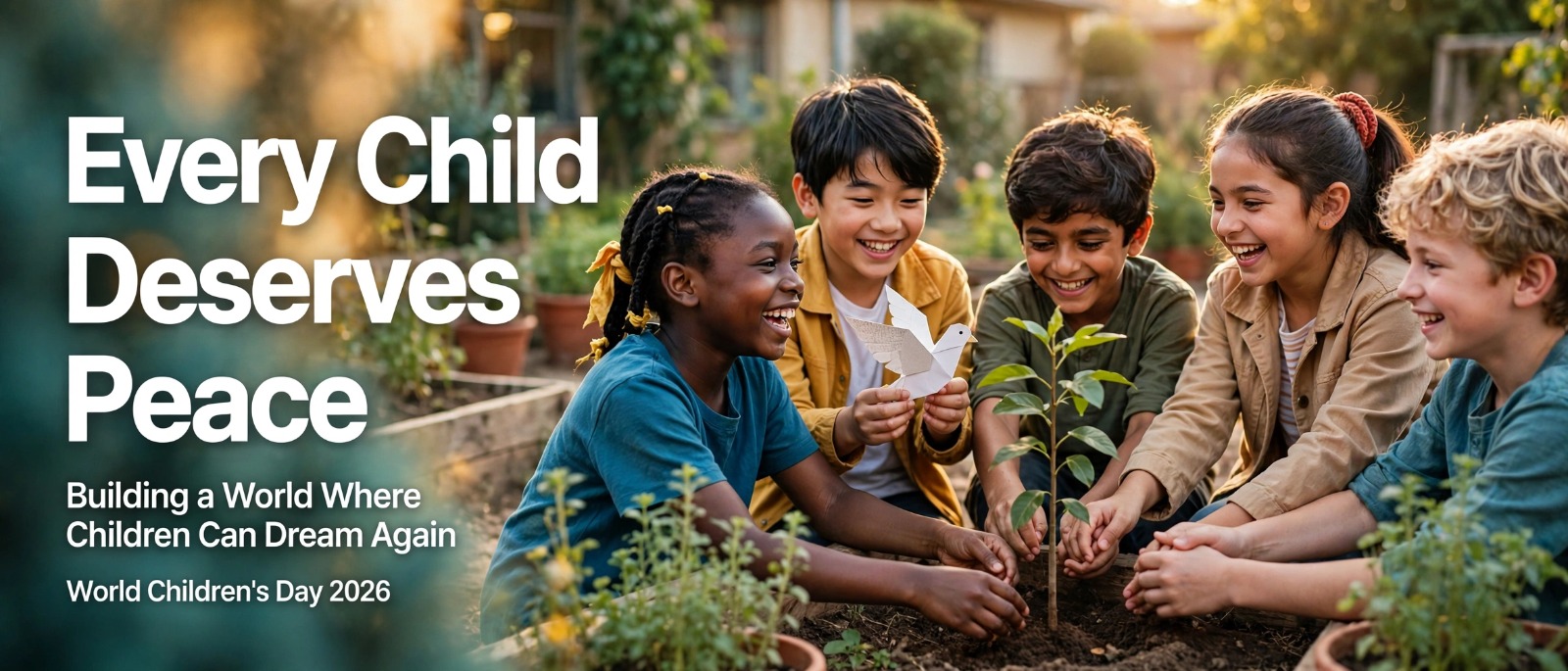
Every Child Deserves Peace: Building a World Where Children Can Dream Again
Global Peace | World Children’s Day 2026
Peace has a sound. It isn’t the scratch of a pen on a treaty, or the applause in a conference hall in Brussels, New York or Addis Ababa. It’s a child laughing without checking over their shoulder. It’s a girl in Accra putting her hand up in class without fear. It’s a football bouncing between boys in Bogotá whose neighbourhoods used to fight and who now play on the same team. It’s a child in Kyiv, Gaza, Khartoum or Yangon going to sleep sure that tomorrow morning will still be safe.
That’s what peace sounds like, and every child should get to hear it. So this World Children’s Day, we at Global Peace want to do more than celebrate children. We want to make them a promise: wherever we have a seat at the table, we’ll use it to push for a world where they can dream again. Right now, too many of them can’t. They’re too busy getting through the day.
The world our children are growing up in
We owe it to children to be honest about the world we’ve handed them.
According to the Peace Research Institute Oslo (PRIO), 589 million children were living in conflict zones in 2025. That’s almost one in four children on the planet, up from about one in ten in the mid-1990s. The same year, researchers at Uppsala University counted 65 armed conflicts involving states, more than in any year since records began in 1946. Thirteen of them were full-scale wars, the most since 1992. Children bear the brunt of everyone.
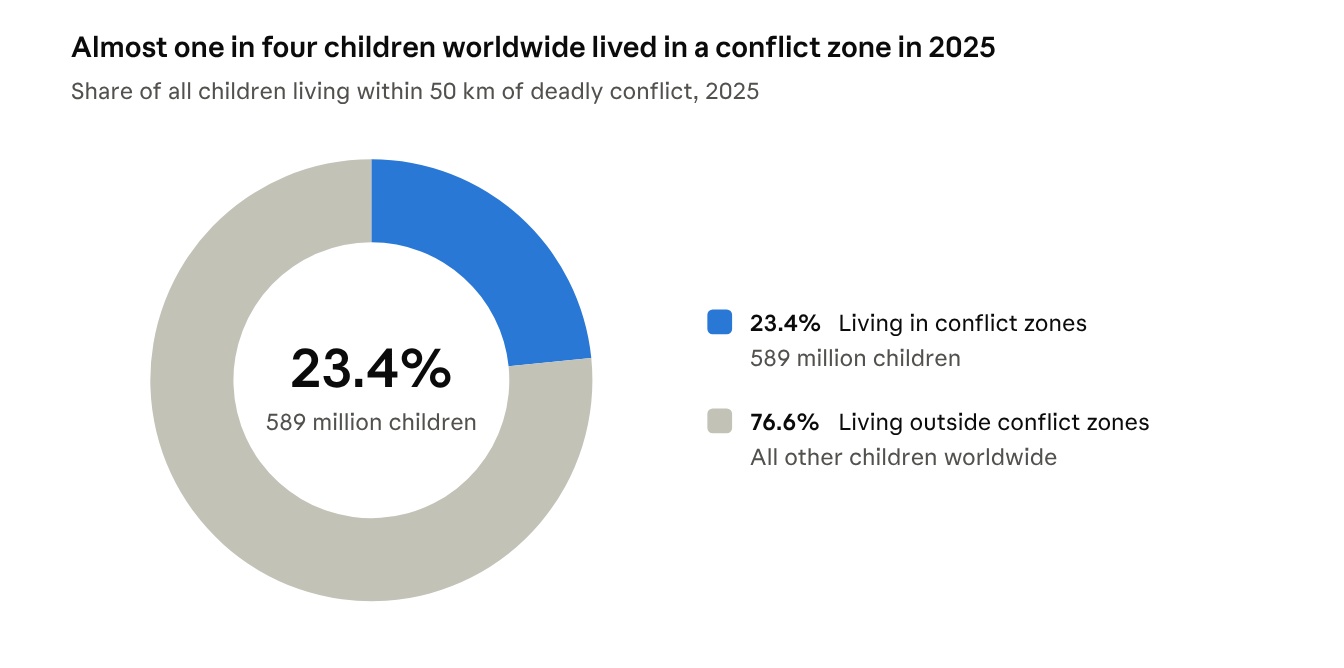
PRIO, More children than ever live in conflict zones, 19 November 2026 (2025 estimate)
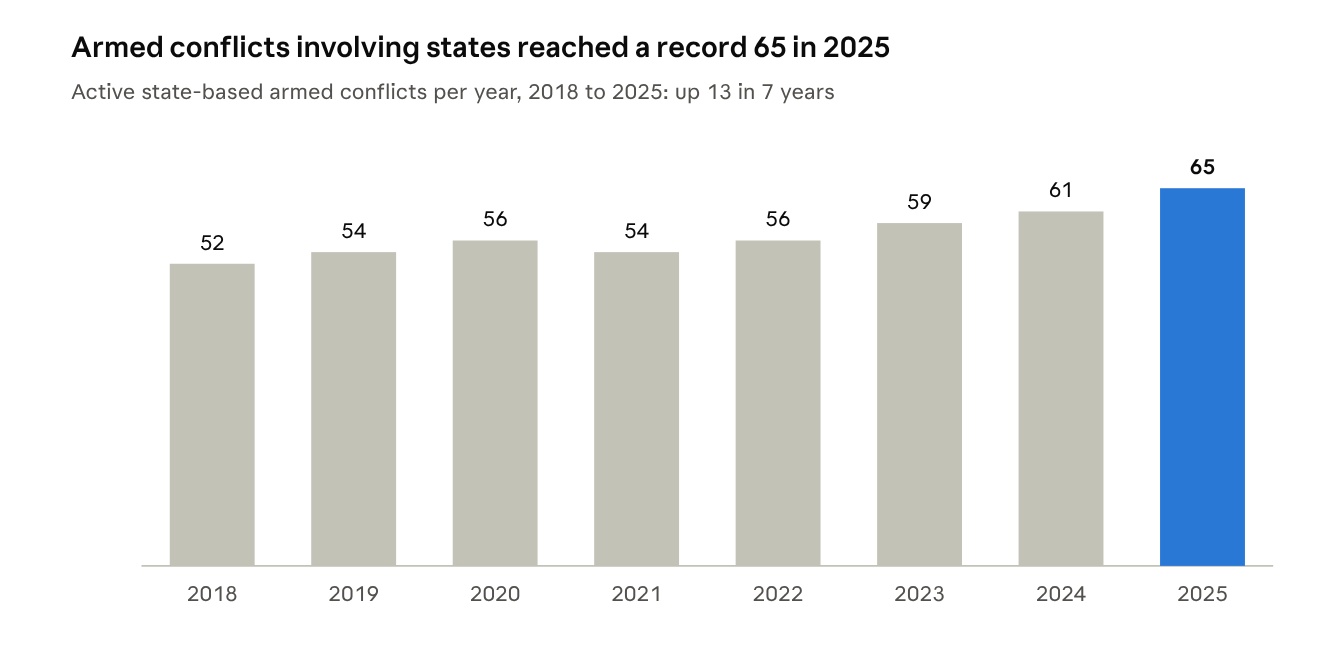
Uppsala Conflict Data Program counts first reported for each year (2018–2025).
Children in these places lose their homes and their schools. Some lose their parents. Almost all of them lose some of their childhood. A girl growing up in a conflict zone isn’t worried about her exams. She’s worried about whether there’ll be water. She isn’t dreaming of becoming a doctor, a pilot or a footballer. She’s hoping for one quiet night.
Even in countries at peace, life isn’t peaceful for many children. UNICEF estimates that at least one in three children under five is undernourished or overweight. Many face violence at home, bullying at school or exploitation online. They’ll inherit a climate crisis they did nothing to cause, and they’re growing up in a digital world that can open doors for them but can also do them real harm. And still, children dream.
We hear it all the time, in our intergenerational dialogues and from our youth peace ambassadors in more than 100 cities. A nine-year-old in Nairobi told us, “I want to be the one who brings water to my village.” A twelve-year-old in Manila said, “I want to be a teacher, so no child feels alone.” They haven’t given up on peace. We can’t give up on them.
Sources: PRIO, November 2026; Uppsala University, June 2026; UNICEF, State of the World’s Children 2019. Full list at the end.
What does peace mean to a child?
Ask a diplomat what peace means and you’ll hear about security, borders and agreements. Ask a child and you’ll usually get a better answer. Peace is walking to school without being scared. It’s three meals a day. It’s a mum and dad who aren’t afraid. It’s playing outside until it gets dark, being listened to, and being allowed to just be a child. That’s why we’ve never seen peace as simply the absence of war. For us, it means dignity, opportunity and love being part of a child’s everyday life.
It’s also why our work rests on what we call Dialogue as Prevention: the idea that peace is made in everyday conversations, long before any conflict starts. It gets built in playgrounds as much as in parliaments, and by parents, teachers and children as much as by presidents.
If we want a more peaceful world in 20 years’ time, the place to start is with children today. A child who learns to settle an argument with words grows into an adult who knows how to make peace. A child who learns to respect someone of a different faith, language or generation grows into a leader who brings people together. Nobody is born knowing how to make peace. It’s learned, and quite often it’s children who end up teaching the rest of us.
What Global Peace advocates for
This year we’re not only celebrating. We’re asking for four specific things.
| Call | What we ask for | Who we ask | Target |
| 1. Child Peace Clubs | Child-led clubs where children learn to listen, speak and solve problems without fighting | Governments, schools, EU, AU, UN | 1,000 clubs in more than 100 cities |
| 2. Safe Online, Safe to Dream | Child-safe settings by default, easy reporting, consequences for platforms that fail to act | Governments, technology companies | Every platform children use |
| 3. Safe Schools, Safe Dreams | Clean water, trained teachers, protection from violence, mental health support | Governments, donors, local partners, universities | 50 cities hit hardest by conflict and climate displacement |
| 4. 1 Million Meals for Peace | Meals for children in conflict-affected communities, delivered through schools | Governments, donors, private sector | 1 million meals |
1. Child Peace Clubs in every community
We want to see 1,000 Child Peace Clubs in schools and communities across more than 100 cities. We’re asking governments, schools, the European Union, the African Union, the United Nations and everyone who works alongside us to help make that happen.
Each club would be run by children, with support from their teachers and guidance from our Youth Peace Ambassadors. The idea is simple: children learn how to listen, how to speak up, and how to sort out problems without fighting. They’d do it through art, music, sport and storytelling: planting peace gardens, writing to children in other countries, organising a Peace Day at school. It’s less a lesson than a place to practise peace.
2. Safe Online, Safe to Dream
Children today grow up online as much as off. The screens that connect them to friends and learning can also expose them to bullying, grooming, exploitation and hate. We’re asking governments and technology companies to build children’s safety into their products from the start, not bolt it on later.
In practice, that means child-safe settings switched on by default, quick and simple ways for a child to report harm, and real consequences for platforms that don’t act. It also means helping children and parents learn how to stay safe, spot manipulation and look out for each other.
Everything children practise in a Child Peace Club, from listening to speaking with respect to standing up for one another, matters just as much online. Peace in the playground should mean peace on the screen too.
3. Safe Schools, Safe Dreams
School should be the safest place in a child’s life. In too many places, it’s anything but. We’re calling for Safe Schools in the 50 cities hit hardest by conflict and climate displacement, working with local partners and universities. That means clean water, properly trained teachers, protection from violence, and mental health support for children who have lived through war. Children can’t learn when they’re hungry, and they can’t dream when they’re afraid. Safe Schools tackle both.
4. 1 Million Meals for Peace
Hunger is its own kind of violence. When a child goes to bed hungry, part of their peace has been taken from them. We’re asking governments, donors and businesses to fund 1 million meals for children in conflict-affected communities, served through schools and local partners. A meal isn’t charity. It gives a child dignity, and it’s what learning, health and hope are built on.
A story that stays with us
Efua is 10 years old. She lives in Accra, Ghana. The first time Efua came to one of our Inter-Generational Dialogues, she didn’t say a word. She sat at the back, holding her mother’s hand. Her mother told us Efua had stopped dreaming. She had seen violence in their neighbourhood and was frightened to walk to school.
The elders spoke first, then the young people. Then the facilitator turned to the room and asked, “What do the children want to say?” Nobody moved. Then Efua put her hand up. “I want a garden,” she said. “A garden where we can all play and grow food together.” People laughed, not at her but out of pure delight. With one sentence, Efua had done something the adults hadn’t managed in years: she’d turned a conversation about conflict into a plan for peace.
Her school has a peace garden now. Children from different families grow vegetables side by side, and share the harvest as well as the work. Efua wants to be a teacher when she grows up. “I want to teach children to dream again,” she told us. She’s the reason we do this work, and there are millions of children like her. Every one of them deserves a garden. Every one of them deserves peace.
What we ask of adults
Children can’t build peace on their own. They need the rest of us. So we’re asking every adult, whether you’re a parent, teacher, leader, donor or policymaker, to make three promises.
- Listen to children. Not for a photo, and not to tick a box, but as real partners. Invite a child into your next meeting, ask what they need, and then do something about it.
- Protect children. From war, hunger, violence and exploitation. A world that can’t keep its children safe has no business calling itself civilised.
- Invest in children. Money spent on a child’s education, health and safety is money spent on peace. Children belong at the heart of peace budgets, not tucked away at the edges.
We’re also asking three institutions for something specific:
| Institution | Our ask |
| European Union | Fund a Child Peace Club in every EU-supported peacebuilding programme that works with schools and communities |
| African Union | Make sure every peace process it leads or supports includes children’s voices |
| United Nations | Make the coming year the one in which the world finally listens to its youngest citizens |
A world where children can dream again
Picture a world where no child ever has to run from war. Where every child goes to school, eats a proper meal and sleeps safely at night.
Where, just as the children we meet so often describe it, a child in Gaza plays with a child in Tel Aviv as a friend, not an enemy. Where a child in Kyiv writes letters to a child in Moscow, and children in Khartoum and Juba kick a football around instead of fighting over a border. Some people will call that naive. We think it’s necessary, and we think it’s possible. It starts small: one conversation, one garden, one meal, one child at a time.
This World Children’s Day, we’re renewing that commitment. We’ll stand with children, we’ll listen to them, and we’ll keep fighting for their right to grow up in peace. Because every child deserves peace, and every child deserves the chance to dream again.
Join us
Become a Child Peace Champion. Back the call for 1,000 Child Peace Clubs. Share this message. And today, find a child in your life and ask them: What does peace mean to you? Then really listen, and let what they say change you. Happy World Children’s Day, from all of us at Global Peace in more than 100 cities across 100 countries. For every child. For every dream. For peace.
Sources
• Children in conflict zones (589 million, 23.4% in 2025): PRIO, More children than ever live in conflict zones, 19 November 2026.
• 65 conflicts and 13 wars in 2025: Uppsala University, UCDP: record number of conflicts between states, 9 June 2026.
• 61 conflicts in 2024: Uppsala University, UCDP: Sharp increase in conflicts and wars, 11 June 2025; PRIO, Conflict Trends: A Global Overview, 1946–2024.
• 2022–2023 (56 and 59 conflicts): Journal of Peace Research, Organized violence 1989–2023.
• 2020–2021 (56 and 54 conflicts): Journal of Peace Research, Organized violence 1989–2020 and Organized violence 1989–2021.
• 2018–2019 (52 and 54 conflicts): Journal of Peace Research, Organized violence 1989–2018 and Organized violence 1989–2019.
• 1 in 3 children under five undernourished or overweight: UNICEF, State of the World’s Children 2019, October 2019.