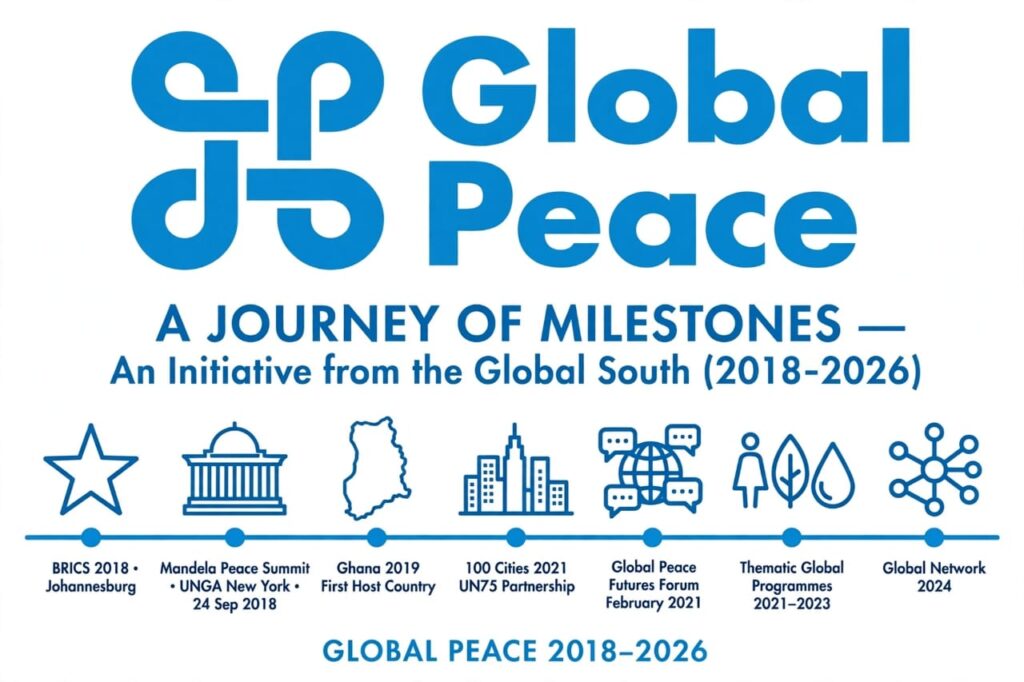
Prior to launching Global Peace at the BRICS Summit in Johannesburg in July 2018 and the UN General Assembly in September 2018, a small group of young people asked a simple question: What if peace was built not from podiums, but from circles? What if dialogue, not directives, became the method?
From that question, Global Peace was born. Today, that method has travelled to 100 cities in 100 countries. It is not a map of pins. It is a network of trust proof that an initiative from the Global South can create a truly global movement for peace.
Dialogue over Imposition: The Global Peace Method
Global Peace was built on one conviction: sustainable peace is not declared at summits; it is practiced in communities. We turned that conviction into a methodology: Intergenerational Dialogues (IGDs).
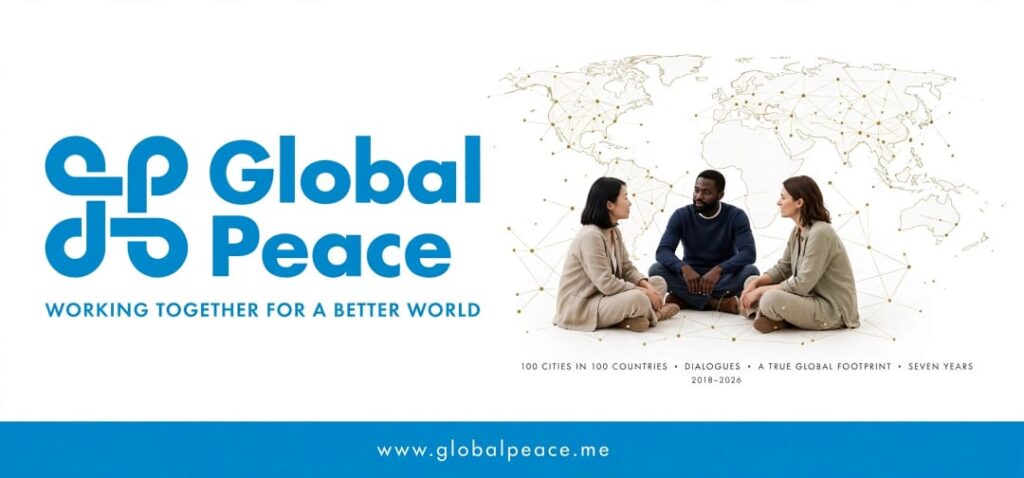
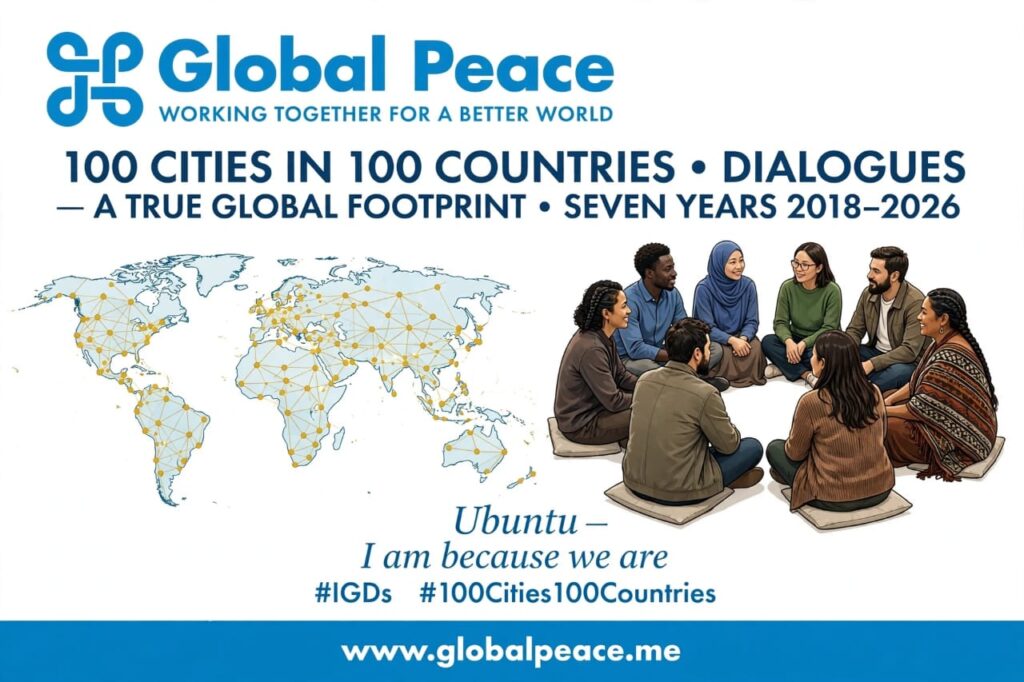
An IGD is intentionally simple. No podium. No panel of experts talking at an audience. A circle where youth, elders, women leaders, traditional authorities, students, migrants, policymakers, and community members sit as equals. One rule, rooted in Ubuntu: I am because we are. Everyone speaks. Everyone is heard.
There are no pre-written communiqués. The agenda is set by the community. In one city, the theme is preventing election violence. In another, it is climate displacement. In another, it is youth unemployment and peace. That simplicity is why it scaled. It did not require massive infrastructure or large budgets. It required safe space, skilled facilitation, and respect. And respect travels.
100 Cities: A Footprint of Trust
100 cities in 100 countries is not a vanity metric. Each city represents a local partner who took ownership, a volunteer facilitator who was trained, and a community that chose to talk instead of turn away.
It began in Africa from Johannesburg, Accra, Nairobi, Kigali, Dakar, Lagos, Cairo, Addis Ababa, Cape Town, Lusaka and Harare where urgent questions defined the dialogues: How do we include young people in national peace processes? How do we heal after conflict? How do we make democracy work for everyone?
It expanded in Asia New Delhi, Mumbai, Jakarta, Kuala Lumpur, Manila, Kathmandu, Dhaka, Bangkok, Beirut, Colombo and Islamabad where conversations centered on pluralism, the role of faith in social cohesion, digital peace, and climate justice.
In Latin America and the Caribbean from Bogota, Lima, Mexico City, Buenos Aires, Sao Paulo, Quito, Guatemala City, San Jose, Port-au-Prince and Port of Spain dialogues linked peace to inequality, indigenous rights, memory, and citizen security.
In Europe Geneva, London, Berlin, Paris, Brussels, Stockholm, The Hague, Belgrade, Vienna and Madrid the dialogues were often hosted in universities, where Global South youth challenged and reshaped northern narratives on migration, decolonizing peacebuilding, and multilateral reforms.
In North America and the Pacific New York, Washington DC, Toronto, Vancouver, Los Angeles, Suva, Auckland and Sydney connecting diaspora communities to home, and bringing community-level insights into global policy spaces.
And critically, in fragile and climate-vulnerable contexts Juba, Bangui, Mogadishu, and Freetown where dialogue was not a workshop topic, but a survival strategy.
Each city adapted the model but kept its modalities. In Accra, the dialogue happened in a hotel. In Geneva, it was hosted virtually. In Kathmandu, youth debated federalism in Nepali. In Bogota, youth shared worries over employment. The language changed but the principle did not.
This is what makes it a true global footprint, not a global tour. Global Peace did not export a franchise. It seeded a practice. Local partners led. Global Peace connected, documented, and amplified.
What We Heard in 100 Cities
Across 100 different contexts, seven common demands emerged a people’s peace agenda:
1. The Intergenerational Gap is a Peace Gap. In 87 of 100 cities, youth said: “We are invited to be seen, not to decide.” Elders said: “We are asked to step aside, not to guide.” IGDs bridge that gap by making decisions shared, not handed down.
2. Peace is Feminine. In every city, women defined peace not as the absence of war, but as the presence of safety, dignity, and opportunity to walk at night, to speak freely, to feed families, to lead. By 2023, 60% of Global Peace dialogues were women-led.
3. Climate is a Peace Issue. From the Sahel to the Sundarbans to Small Island Developing States, climate change was named as a primary driver of conflict, displacement, and food insecurity. Communities demanded climate justice as peace justice.
4. Dignity over Aid. Participants across the Global South were clear: they do not want to be beneficiaries of peace programs designed elsewhere. “We are not waiting for peace to be given to us. We are building it.” That ethos shaped everything.
5. Culture is Infrastructure. Music, proverbs, prayer, poetry, and shared food opened dialogues where politics failed. In Kigali, a song. In Beirut, a poem. In Bogota, a shared sancocho. Culture builds bridges faster than policy.
6. Digital Dialogue is Real Dialogue. During COVID-19, Global Peace moved to virtual circles. 42 cities went online in 2020-2021, proving that if the space is safe and facilitation is strong, trust transcends physical distance.
7. Local Ownership is Non-Negotiable. The most sustainable dialogues were those where local government, universities, or youth organizations put dialogue into their own budgets and plans not as a project, but as a practice.
The Numbers behind the Footprint
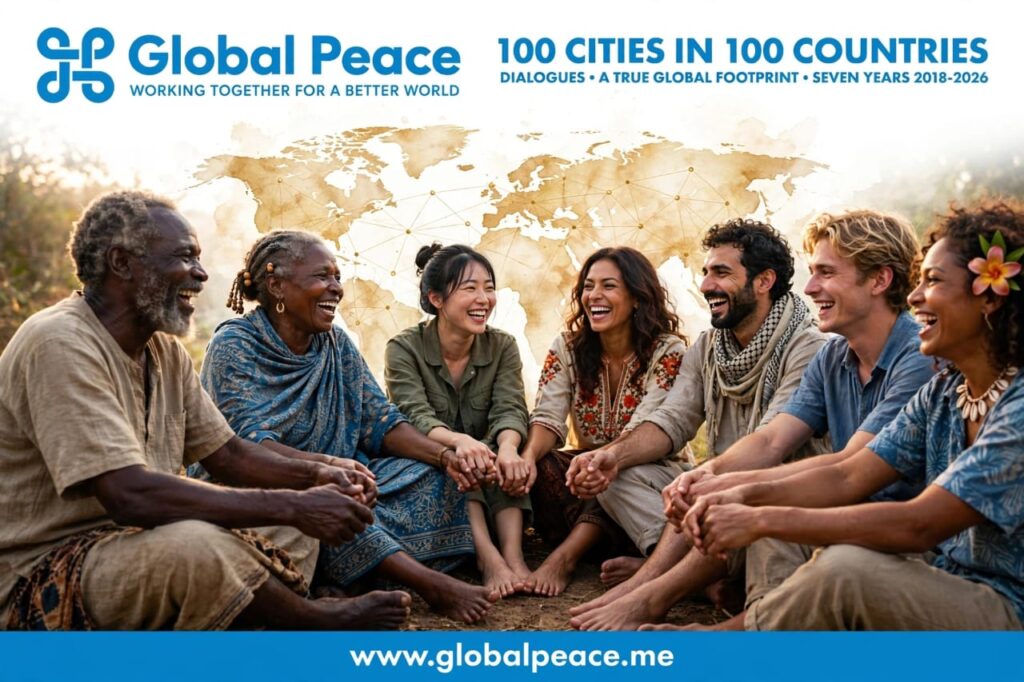
During the last 7 years (2018-2026), the 100 cities in 100 countries dialogue attracted more than 100,000 direct participants where 60% were under age 30 and 58% were women and gender-diverse persons. The programme hosted over 1500 local partner organizations and over 500 volunteered as conveners of the dialogues and were trained as peace facilitators under the Global Peace initiative. Over 100 cities action plans emerging directly from the dialogues.
But the true footprint cannot be counted. It is the student in Nairobi who became a county peace coordinator after her first IGD. The youth in Port of Spain who left a group to facilitate dialogues in schools. The grandmother in Delhi who taught a young activist how to breathe through trauma. The Indian and Pakistani students in London who discovered they share the same proverbs about peace.
Global Peace never claimed attribution for these ripples. That is intentional. A real footprint is not centrally controlled. It is locally owned.
Why an Initiative from the Global South Matters
For decades, peacebuilding flowed in one direction: expertise and funding from North to South. Global Peace inverted that flow.
Its blueprint comes from the Global South, from Ghana’s palaver hut, from India’s panchayat, from South Africa’s lekgotla, from Colombia’s circulos de palabra, from Pacific talanoa. It proved that the Global South has not just problems to be solved, but solutions to share.
In 2026, as trust in multilateral institutions is strained and conflicts multiply, this model is more relevant than ever. The world does not need another headquarters for peace. It needs a network of circles where adversaries become neighbours, where young people are co-architects, not afterthoughts.
Working Together for a Better World – The Next 100
The Global Peace logo explains our philosophy. The Mpatapo, the Adinkra symbol of reconciliation and peace-making four interlinked loops, none above the other, all bound together. And our tagline: WORKING TOGETHER FOR A BETTER WORLD.
The first 100 cities proved it is possible. The next 100 must prove it is sustainable.
100 cities in 100 countries once seemed impossible for a volunteer-led initiative from the Global South. It is done not by one organization, but by thousands who believed dialogue is stronger than imposition. The footprint is real. It spans deserts, deltas, islands, and megacities. It speaks in over 40 languages.
Global Peace | An Initiative from the Global South | From BRICS 2018 Johannesburg to UNGA Sep 2018 | 7 Years of Impact (2018-2026) www.globalpeace.me | #IGDs #100Cities100Countries