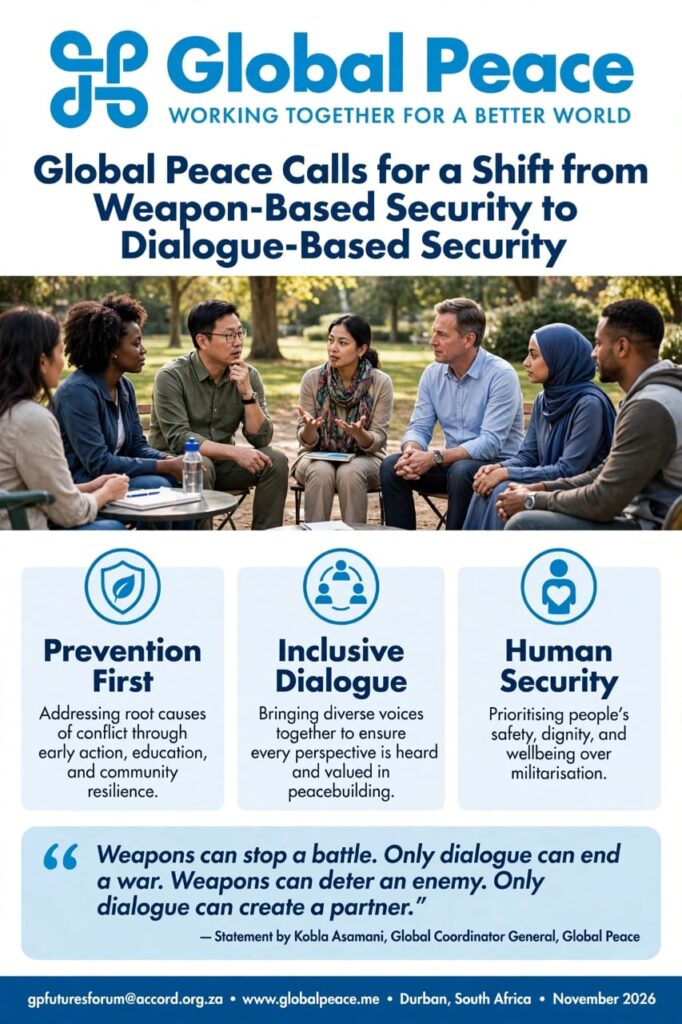
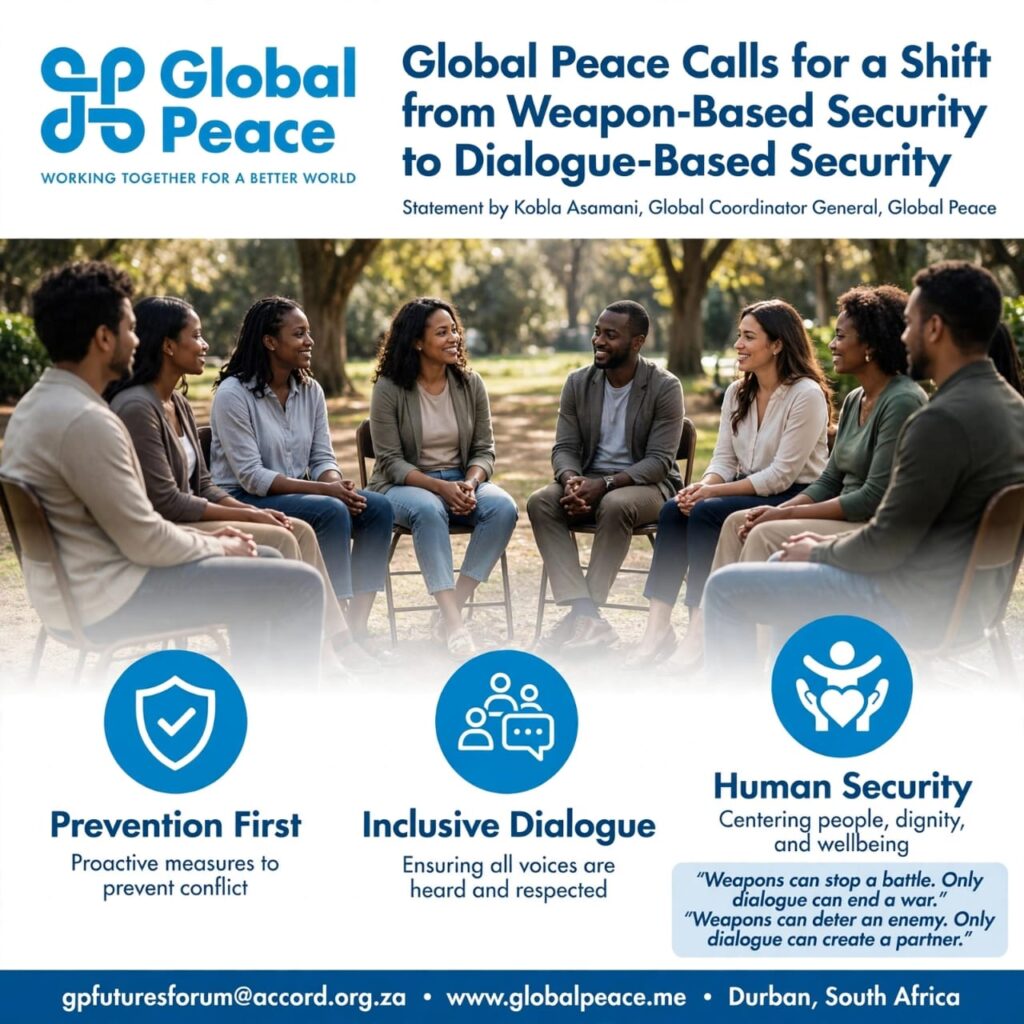
Statement by Kobla Asamani, Global Coordinator General, Global Peace
Global Peace today calls for a fundamental shift in how the world defines security from a system built on weapons, deterrence, and military spending, to a system built on dialogue, diplomacy, and prevention.
The call comes at a time when global military expenditure has reached a record $2.44 trillion, while the number of violent conflicts worldwide has reached its highest level since the Second World War.
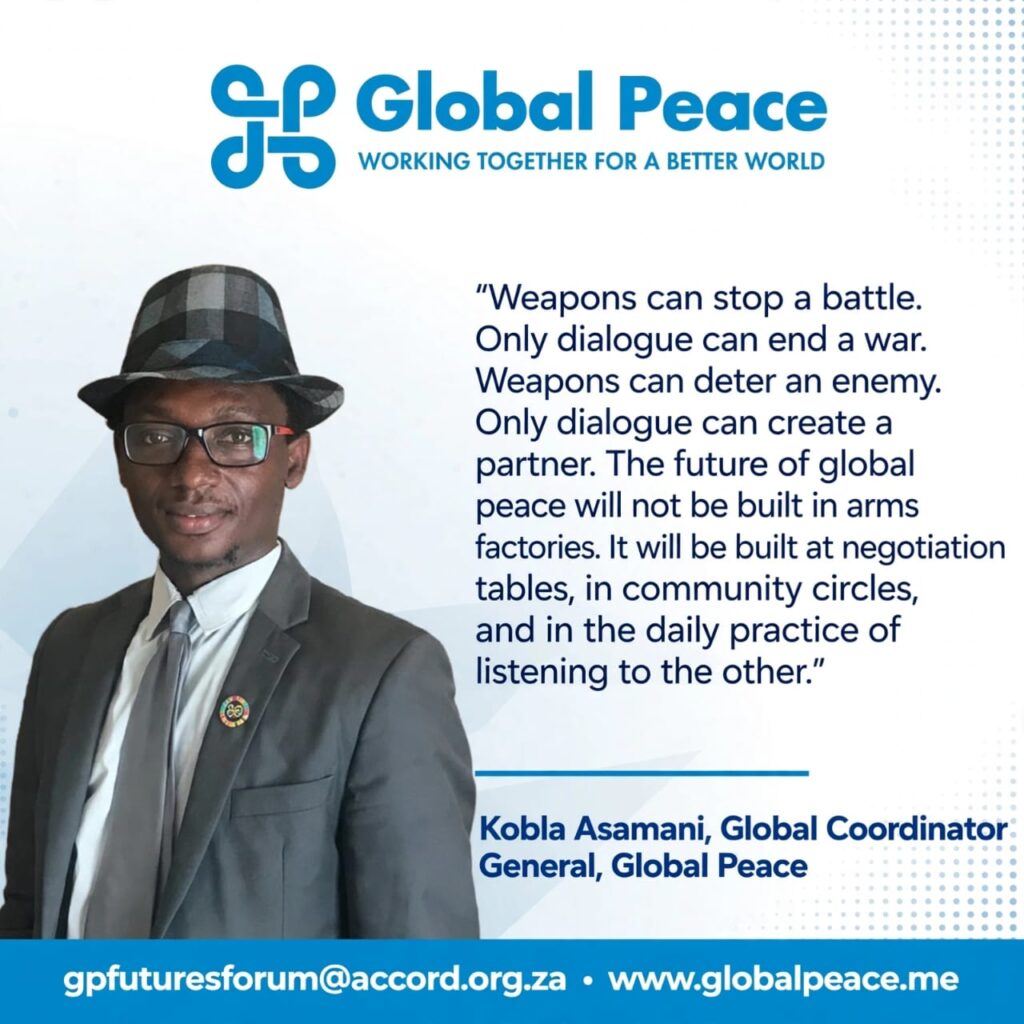
Mr. Kobla Asamani, the Global Coordinator General of Global Peace said, “We are spending more on weapons than ever before, yet we are less secure than ever before. This is proof that weapon-based security alone cannot deliver peace. Peace is not secured by preparing for war. It is secured by preparing for dialogue.”
A Global System Under Strain
Global Peace notes that the current security architecture, rooted in the doctrine of Si vis pacem, para bellum if you want peace, prepare for war has produced only what peace scholar Johan Galtung called “negative peace”: the temporary absence of direct violence, while structural violence in the form of poverty, inequality, and exclusion remains.
In contrast, dialogue-based security seeks “positive peace” addressing the root causes of conflict through inclusive political processes, mediation, and development.
What Dialogue-Based Security Means
According to Mr. Asamani, dialogue-based security is defined as:
1. Prevention first through investing in early warning, mediation, and preventive diplomacy before conflicts turn violent.
2. Inclusive Dialogue by ensuring women, youth, faith leaders, and local communities have a seat at every peace table.
3. Ensuring Human Security shifting focusing from the security of territory to the security of people freedom from fear, freedom from want, and freedom to live in dignity.
In Line With the United Nations
This statement aligns with the United Nations Secretary-General’s A New Agenda for Peace (2023), which warned that the world is at an inflection point and called for a quantum leap in preventive diplomacy and a renewed commitment to political solutions.
It also aligns with the UN’s Sustaining Peace agenda and the Pact for the Future (2024), which commits member states to revitalize mediation and strengthen the Peacebuilding Commission.
Global Peace further draws on the African philosophy of Ubuntu “I am because we are” and the tradition of Palaver, where communities resolve disputes through consensus, as evidence that dialogue-based security is not a new idea, but a return to deeply rooted human practice.
A Call to Action
Global Peace calls on governments, regional bodies, and international institutions to:
- Double funding for UN mediation and peacebuilding by 2030.
- Make dialogue the first resort and force the last resort, in line with the UN Charter.
- Reallocate a portion of military spending toward education, health, climate adaptation, and dialogue infrastructure.
Mr. Asamani concluded that “Weapons can stop a battle. Only dialogue can end a war. Weapons can deter an enemy. Only dialogue can create a partner. The future of global peace will not be built in arms factories. It will be built at negotiation tables, in community circles, and in the daily practice of listening to the other.”