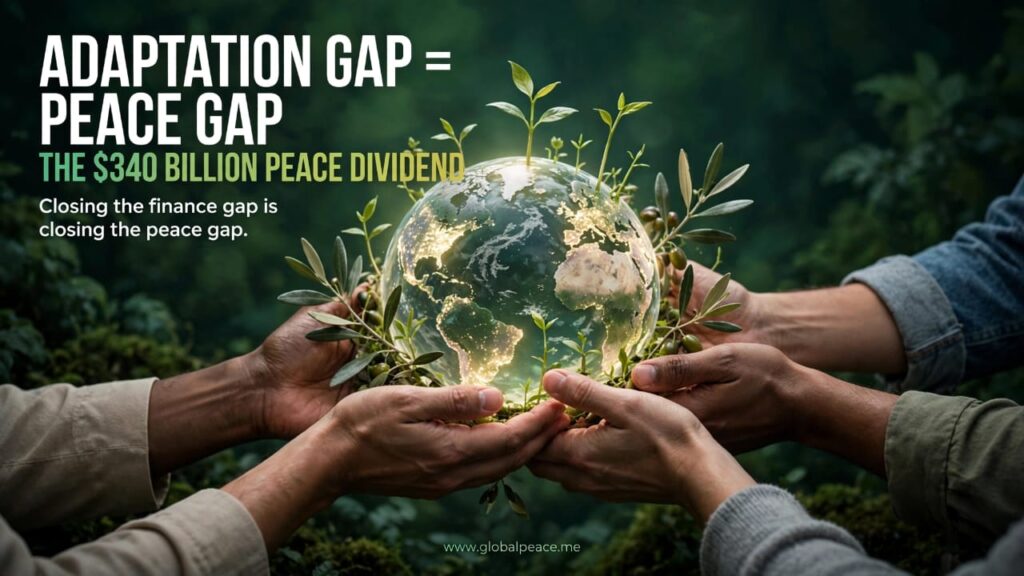
Inspired by Nature — For Climate, For Our Future
At Global Peace, we believe peace is more than the absence of war. It is the presence of resilience. And today, the greatest threat to that resilience is not being addressed where it matters most.
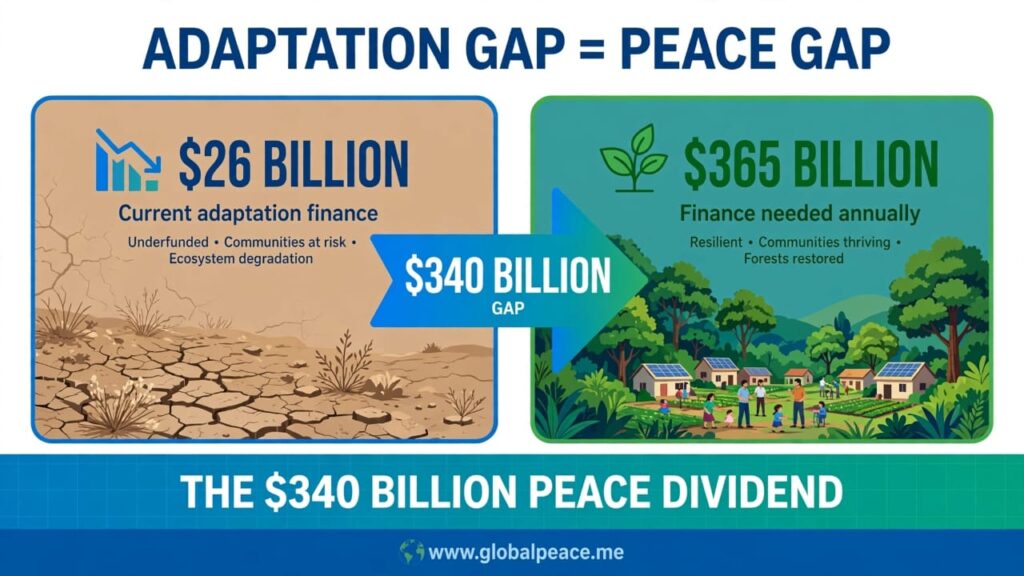
The numbers are stark. The United Nations Environment Programme’s Adaptation Gap Report 2024 reveals that international public adaptation finance fell to US$26 billion in 2023, down from US$28 billion the year before, while developing countries will need US$310–365 billion annually by 2035 to adapt to escalating climate impacts (UNEP, 2024). In other words, developing countries are receiving just a fraction of the finance they need to prepare.
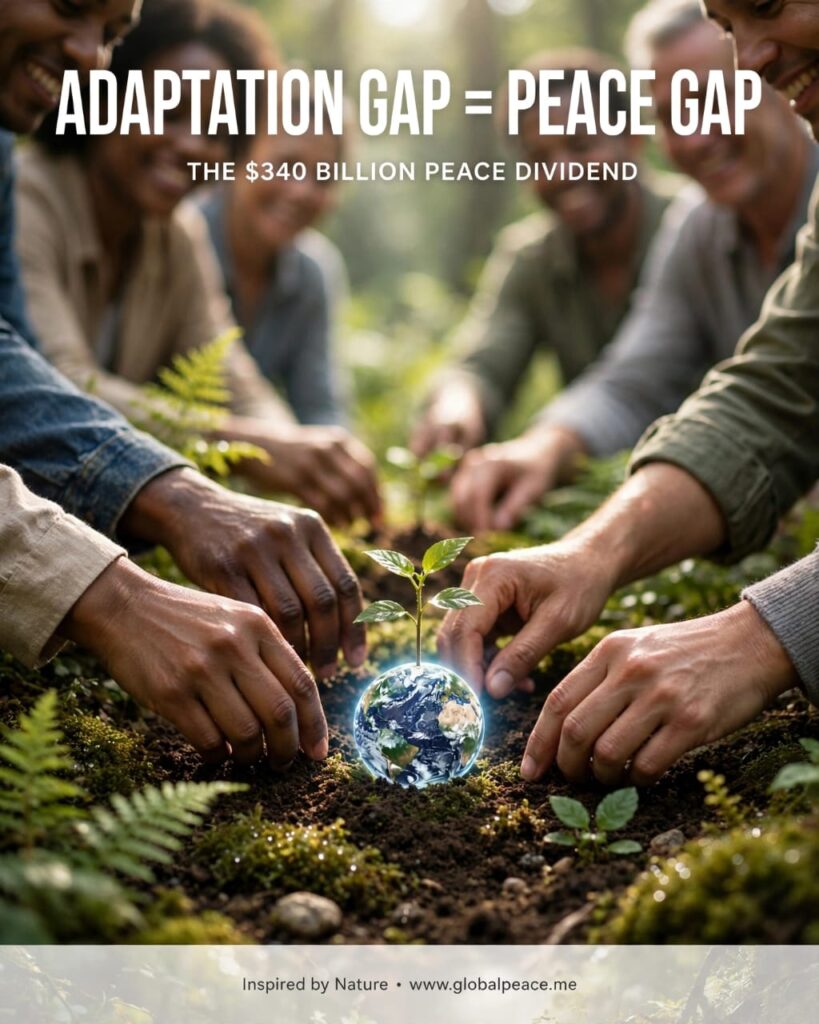
This is not only a climate finance gap. It is a peace gap. And closing it is the largest peace dividend of any century.
When Adaptation Fails, Peace Fails
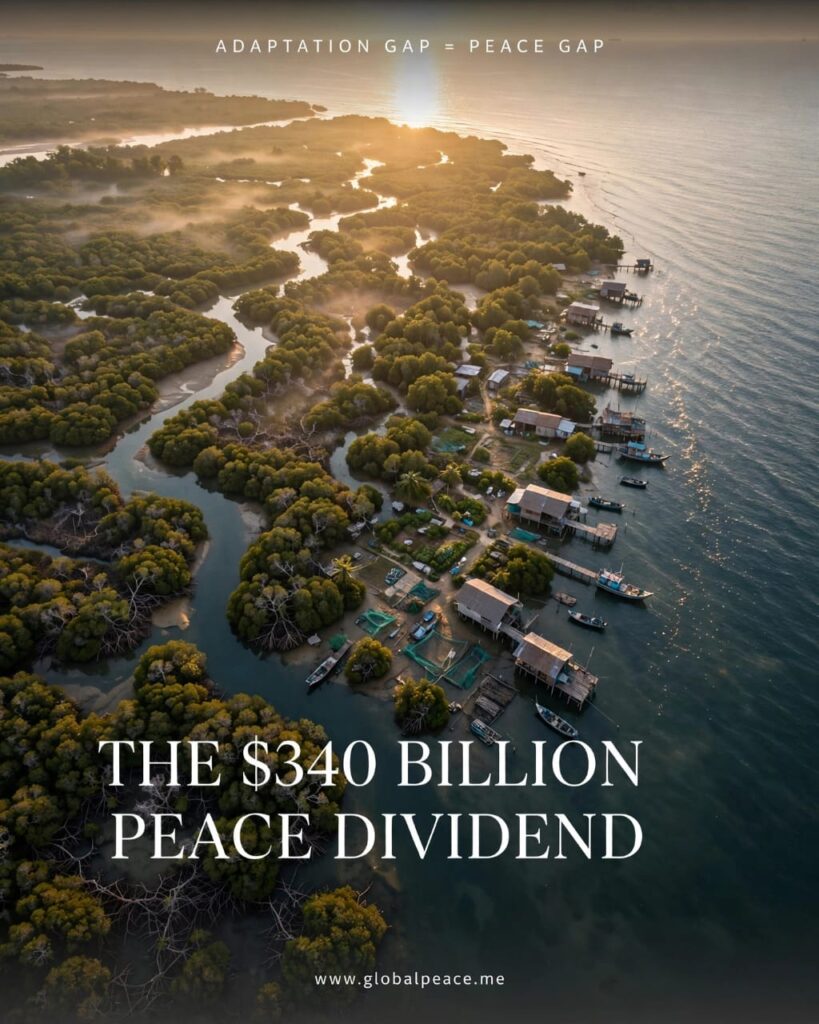
In the Sahel, adaptation is a drought-resistant seed variety that allows a farmer to harvest despite a shortened rainy season. In Bangladesh, it is a mangrove belt that saves a fishing village from storm surge. In Small Island Developing States, it is a desalination system that keeps fresh water available.
When these systems fail not because solutions do not exist, but because finance does not arrive; people are left with impossible choices. The UN’s own climate security analysis warns that climate change does not automatically create security risks, but through interaction with existing social, economic, and demographic pressures, it can multiply risks, exacerbate drivers of insecurity, and threaten efforts to prevent conflict and sustain peace (UN, 2023).
This is why we think adaptation as peacekeeping.
The Math of Injustice: 12 Times Less Than Needed
UNEP (2024) warns that adaptation needs are now 12 to 14 times higher than current funding flows. At COP26 in Glasgow in 2021, countries agreed that developed nations should collectively double adaptation finance from 2019 levels of US$18.8 billion to US$40 billion annually by 2025. Yet OECD data show adaptation finance reached US$34.7 billion in 2024, up slightly from US$33.6 billion, and developed countries would still need to provide an additional US$5.8 billion in 2025 to meet the target (OECD, 2024).
Meanwhile, the real need as expressed in developing countries’ own Nationally Determined Contributions and National Adaptation Plans rises to approximately US$365 billion annually by 2035 when those national documents are extrapolated (UNEP, 2024).
This US$339 billion difference between what is provided (US$26bn) and what is needed (US$365bn) is what we call the Peace Gap.
It is less than 13% of global military expenditure, which reached a record US$2.718 trillion in 2024 (SIPRI, 2025). Global military expenditure is rising while adaptation finance is falling, with national militaries contributing an estimated 5.5% of global greenhouse gas emissions (Scientists for Global Responsibility, 2022).
We are investing in the tools of war while disinvesting from the tools of peace.
3. Nature Is the Cheapest Peacekeeper
The most effective adaptation solutions are also the most natural, affordable, and peace-promoting.
Our tagline Inspired by Nature — For Climate, For Our Future reflects a simple truth: nature has already negotiated the best adaptation treaty.
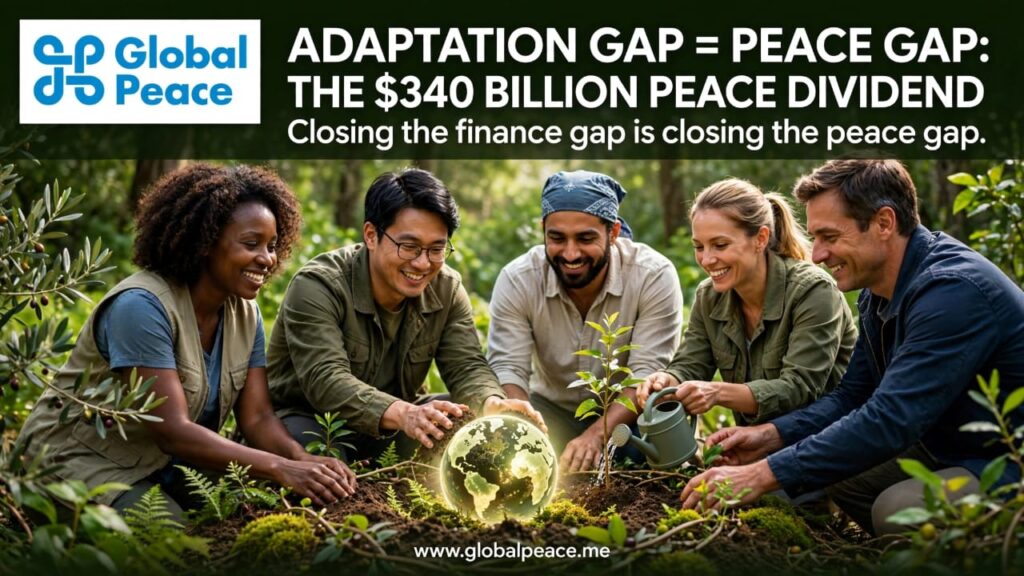
Mangroves, agroforestry in Ghana, and community-led early warning systems cost a fraction of grey infrastructure but deliver food security, water security, and social cohesion. UNEP (2024) itself notes that while 171 countries have formally adopted national adaptation policies, actual implementation remains severely restricted by the lack of capital.
Turning Finance into Peace
What would it mean to treat adaptation finance as peace finance? At Global Peace, we propose three shifts:
Shift 1: From Aid to Security Investment. Adaptation finance is collective security. When Fiji is more resilient to cyclones, when the Horn of Africa has drought-resilient food systems, the entire world is more stable. This aligns with our motto: Working Together for a Better World.
Shift 2: From Top-Down to Community-Led. Our movement is Celebrating, Empowering and Uniting. Adaptation that works celebrates Indigenous knowledge and empowers local communities.
Shift 3: From Risk to Dividend. Every US$1 invested in adaptation yields US$ 4 – 7 in avoided losses (Global Commission on Adaptation, 2019). If the US$339bn gap were closed, it would generate over US$1.3 trillion in avoided damages and stability. That is the peace dividend.
Why This Matters Now
We cannot have peace on a dead planet. And we cannot protect the planet without peace.
At Global Peace, an initiative of the African Centre for the Constructive Resolution of Disputes (ACCORD), which has 34 years of experience working closely with the United Nations, African Union, and Regional Economic Communities to mitigate conflict, we know that peacebuilding has always been about building resilience. Today, resilience means adaptation.
Signing the Peace Treaty with the Future
The Adaptation Gap Report is not just a climate report. It is a peace and security report. It tells us that the world is gearing up for climate resilience without the money to get there.
We have a choice. We can continue to let international public adaptation finance fall to US$26 billion while needs rise to US$365 billion. Or we can choose to invest in the US$339 billion peace dividend. That investment is not a cost. It is the most cost-effective peace agreement ever written.
Join us at Global Peace. Let’s close the adaptation gap. Let’s close the peace gap.
References
Global Commission on Adaptation. (2019). Adapt now: A global call for leadership on climate resilience. https://gca.org
OECD. (2024). Climate finance provided and mobilised by developed countries in 2013-2022. OECD Publishing.
Scientists for Global Responsibility. (2022). The environmental impact of the military. https://www.sgr.org.uk
Stockholm International Peace Research Institute. (2025). SIPRI yearbook 2025. Oxford University Press.
United Nations. (2023). A new agenda for peace (Policy Brief No. 9). https://www.un.org
United Nations Environment Programme. (2024). Adaptation gap report 2024: Come hell and high water. UNEP.