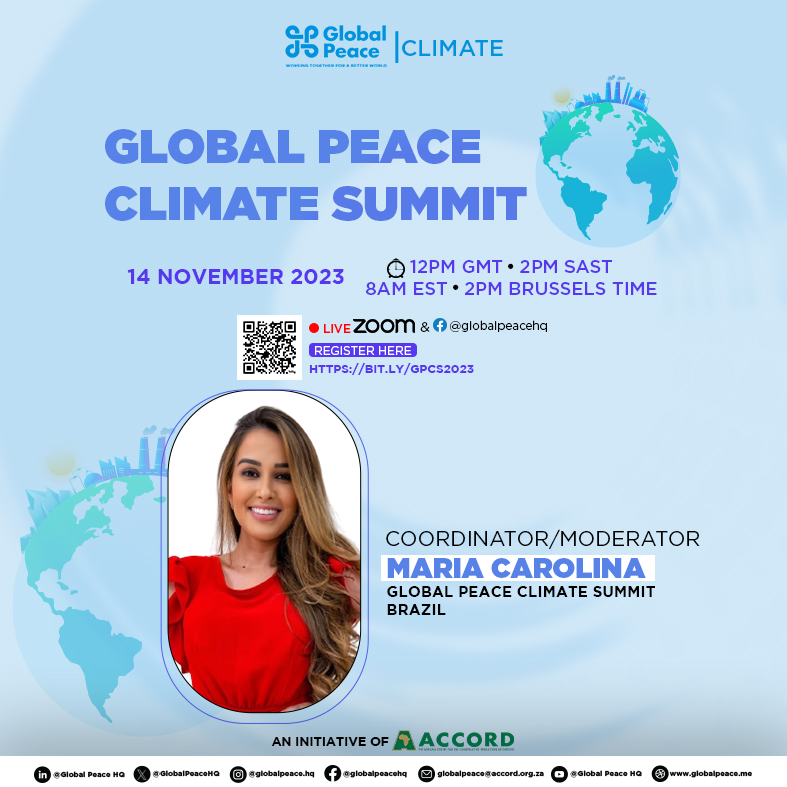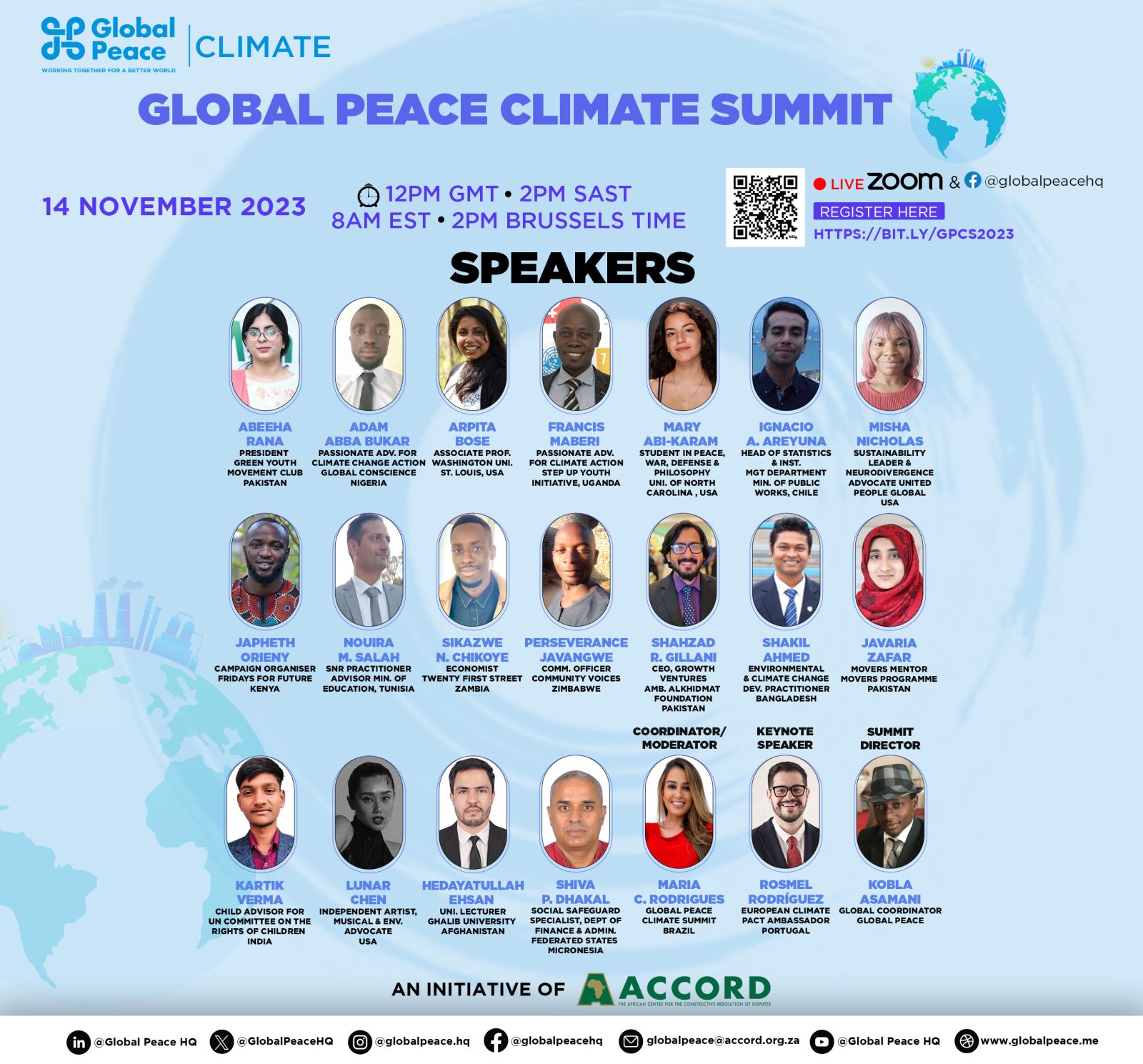
On 14 November 2023, Global Peace brought together a global youth constituency to hold a Climate Summit on the theme: “Mobilizing Global Peace Citizens to Mitigate Climate Emergency”. The Global Peace Climate Summit 2023 is grounded in the third pillar of Global Peace, which is to “Protect and sustain our environment”. Based on the third principle of Global Peace, the “PLANT TREES NOT BOMBS” campaign was instituted to assist in combating climate change. This was made possible through a symbolic planting of a “Tree of Peace” at the Durban International Convention Centre in South Africa, home of Africa’s first Nobel Peace Prize laureate, Inkosi Albert Luthuli. The objective of the PLANT TREES NOT BOMBS campaign is to serve as a tool for use by Global Peace in Climate Mitigation.
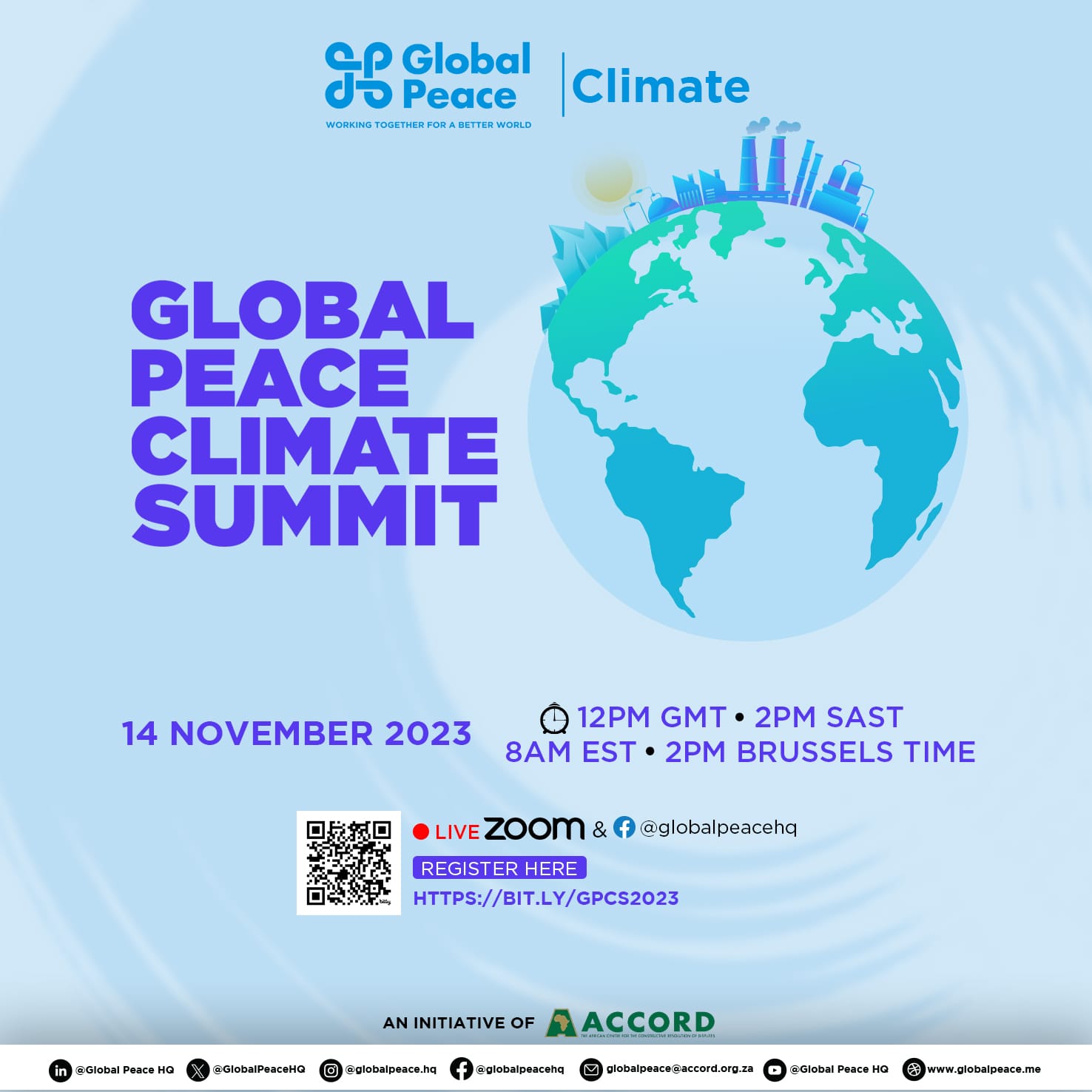
The Global Peace Climate Summit 2023 noted that all around the world, storms, floods and wildfires are intensifying. Speakers further underscored that air pollution sadly affects the health of tens of millions of people and unpredictable weather causes untold damage to homes and livelihoods too. Speakers therefore called on countries to avert this crisis by joining forces urgently. The Global Peace Climate Summit was held ahead of COP28 to mobilise Global Peace Citizens around the world towards taking action to mitigate the Climate Emergency.
The Climate Summit 2023 was designed to explore diverse conversations on Climate, Peace and Security with young climate activists, leaders and stakeholders in government, private sector, academia, and civil society, on topical issues of Climate concern ahead of the United Nations Climate Change Conference, COP28 to be held in the United Arab Emirates. Distinguished panellists at the summit were selected from Brazil, Portugal, Pakistan, Bangladesh, Zambia, Zimbabwe, Chile, United States of America, India, Tunisia, Afghanistan, Nigeria, Uganda, Kenya and Micronesia.
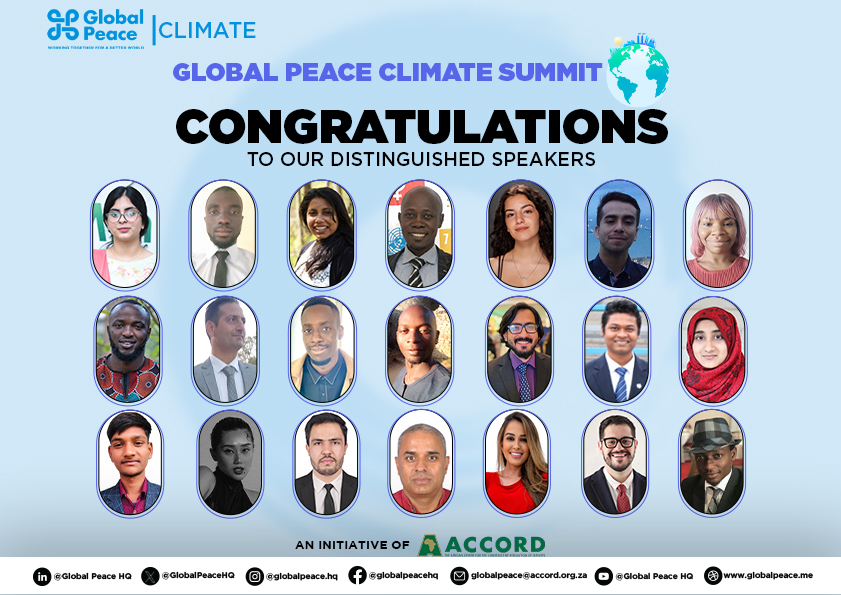
According to the Global Peace Climate Summit, even though there are many opportunities, global leaders are not acting fast enough to avert these crises, and it called on countries to join forces urgently.
The 2023 United Nations Climate Change Conference, more commonly referred to as Conference of the Parties of the UNFCCC, or COP28, is the 28th United Nations Climate Change conference and was held from 30 November to 13 December 2023 in the United Arab Emirates. More than 100 heads of state and representatives of 190 countries were expected to attend. The conference has been held annually since the first UN climate agreement in 1992. It is used by governments to agree on policies to limit global temperature rises and adapt to impacts associated with climate change. At COP21 in Paris in 2015, something momentous happened for the first time: every country agreed to work together to limit global warming to well below 2 degrees and aim for 1.5 degrees, to adapt to the impacts of a changing climate and to make money available to deliver on these aims. The commitment to aim for 1.5 degrees is important because every fraction of a degree of warming results in the tragedy of many more lives lost and livelihoods damaged.
Under the Paris Agreement, countries committed to bring forward national plans setting out how much they would reduce their emissions – known as Nationally Determined Contributions, or ‘NDCs’. They agreed that every five years they would come back with an updated plan that would reflect their highest possible ambition at that time. In the run-up to the summit in Glasgow (delayed by a year due to the pandemic) when countries updated their plans for reducing emissions, their commitments laid out in Paris did not come close to limiting global warming to 1.5 degrees, and the window for achieving this is closing. The decade out to 2030 will be crucial. So as momentous as Paris was, countries must go much further to keep the hope of holding temperature rises to 1.5 degrees alive.
To tackle the climate crisis and now a cost-of-living crisis, we need to urgently remake our energy system. How can we democratise and green our energy system by 2030? How can we ensure a renewable energy system doesn’t replicate the extractive and colonial systems embedded in the fossil fuel energy system? What policies are needed and what are the biggest challenges we must overcome?
As António Guterres, Secretary-General of the United Nations, said at the launch of the World Meteorological Organization’s Provisional State of the Global Climate Report 2022 in Sharm el-Sheikh, Egypt, on 6 November 2022, as part of COP27, our planet is sending a distress signal. According to Guterres, the latest State of the Global Climate report is a chronicle of climate chaos. As the World Meteorological Organization shows so clearly, change is happening with catastrophic speed — devastating lives and livelihoods on every continent. The UN also underscored how the last eight years have been the warmest on record, making every heatwave more intense and life-threatening, especially for vulnerable populations. Sea levels are rising at twice the speed of the 1990s – posing an existential threat for low-lying island states, and threatening billions of people in coastal regions.
The Secretary-General further stated that glacier melt records are themselves melting away, jeopardising water security for whole continents. He called for people and communities everywhere to be protected from the immediate and ever-growing risks of the climate emergency, which is why there is a need to push hard for universal early warning systems within five years. Guterres also called for a strong response to the planet’s distress signal: ambitious, credible climate action. COP28 is the place, and now must be the time.
About the Programme Coordinator – Maria Carolina: Brazil
Maria Carolina is a 31-year-old Brazilian. Her main objective as a woman, beauty queen and professional is to inspire female leadership around the world. Maria Carolina uses her social media and marketing skills and her voice on a beauty pageant platform to promote hope across borders and take her message to every girl and woman in the world.