A Crisis That Knows No Borders
Climate change is no longer only an environmental crisis. It is a crisis of peace. The years from 2015 to 2025 were the warmest eleven years ever recorded, and recent multi-year averages have now crossed the 1.5°C line set in the Paris Agreement (World Meteorological Organization [WMO], 2026). The droughts are longer. The floods are deadlier. The storms are stronger. And each shock falls hardest on communities that are already poor, already excluded and already divided.
Yet the world’s answer has been to buy more weapons. In 2025, nations spent a record US$2.887 trillion on their militaries, the eleventh year of growth in a row, according to the Stockholm International Peace Research Institute (SIPRI, 2026). We are arming against one another while a common threat advances against us all. Weapons cannot stop a drought. Tanks cannot turn back the sea.
As world leaders gather in Antalya, Türkiye, for COP31 (Khaleej Times, 2026), this article asks three questions. How is climate change reshaping peace? How is it changing the way conflicts begin and endure? And why are the security institutions we built for the last century struggling to meet the challenge of this one? The answer, I will argue, lies in dialogue.
Key terms are defined in Appendix A, a timeline of major climate-security milestones is set out in Appendix B, and notes on the data used in the figures and table appear in Appendix C.
Understanding the Nexus
Let us be clear. Climate change rarely starts a war by itself. It makes existing problems worse (Intergovernmental Panel on Climate Change [IPCC], 2022). That is why security experts call it a “threat multiplier” (CNA Military Advisory Board, 2007). It deepens poverty, sharpens competition for land and water, and exposes governments that are weak, unfair or absent. Where institutions are strong and inclusive, communities adapt. Where they are weak or captured by a few, scarcity turns neighbours into rivals. Researchers still debate how strong the link is (Buhaug, 2010; Hsiang et al., 2013). But a landmark expert review in Nature found that climate has influenced between 3% and 20% of armed conflict risk over the past century, while low development and weak state capacity matter far more (Mach et al., 2019).
This matters, because the easy story is the wrong story. To say “drought causes war” lets leaders blame the weather for the failures of politics. The truth is harder and more hopeful. Climate change is a test of our institutions. It asks whether we can share what is scarce, settle disputes peacefully and protect the most vulnerable (Barnett & Adger, 2007). Where the answer is yes, there is peace. Where the answer is no, there is conflict.
The link also runs both ways. War destroys the very things communities need to adapt: farms, irrigation, markets and trust (Peters et al., 2020). And armies are themselves major polluters. Researchers estimate that the world’s armed forces produce around 5.5% of global greenhouse gas emissions (Parkinson & Cottrell, 2022). Insecurity deepens climate vulnerability. Climate vulnerability deepens insecurity. Unless we break this cycle, it will break us.
How Climate Change Is Reshaping Conflict
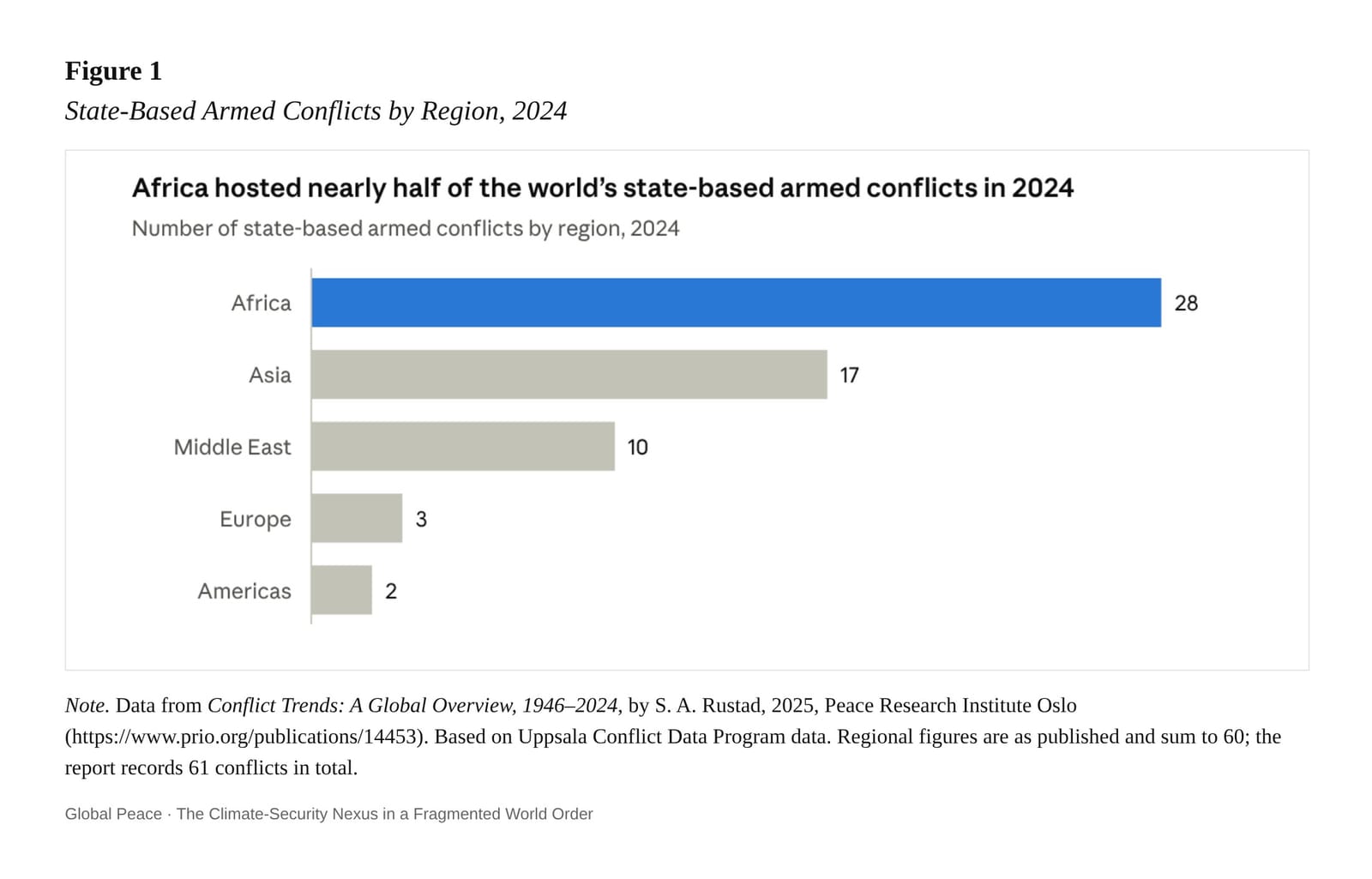
Figure 1. State-based armed conflicts by region, 2024. Note. Data from Conflict Trends: A Global Overview, 1946–2024, by S. A. Rustad, 2025, Peace Research Institute Oslo (https://www.prio.org/publications/14453). Based on Uppsala Conflict Data Program data.
The world recorded 61 state-based armed conflicts in 2024, the highest number since 1946 (Rustad, 2025). Not every one is linked to climate, but many of the regions carrying the heaviest burden of conflict, above all Africa, are also among the most exposed to climate stress.
The Sahel. For generations, farmers and herders shared the land through custom, timing and trust. Rising heat and unreliable rains have broken that rhythm. Pasture shrinks, herders move earlier and further south, and old agreements over grazing routes and water points collapse (Benjaminsen et al., 2012). Armed groups step into the gap, posing as protectors of one community against another and recruiting young people who see no future in a dying landscape.
The Lake Chad Basin. By widely cited estimates, Lake Chad has lost as much as 90% of its surface since the 1960s. Millions of people in Chad, Cameroon, Niger and Nigeria depend on it to fish, farm and graze. As livelihoods have shrunk, exclusion and poor governance have done the rest, giving violent extremist groups a ready supply of recruits (Okpara et al., 2015).
The Horn of Africa. In Somalia, Kenya and Ethiopia, rainy season after rainy season has failed. Livestock has died, harvests have withered, and families have been forced to move. Where conflict already existed, drought has deepened hunger and set communities against each other in the struggle for what little remains (Raleigh & Kniveton, 2012; von Uexkull et al., 2016).
South Asia. The 2022 floods in Pakistan affected some 33 million people and showed how one disaster can overwhelm a nation. Water has also become a source of danger between nuclear-armed neighbours. In April 2025, India placed the Indus Waters Treaty “in abeyance”, and Pakistan warned that any attempt to divert its water would be treated as an act of war (Dawn, 2025). A treaty that survived decades of rivalry is now under strain, at the very moment climate change makes the rivers less reliable.
The Middle East and North Africa. This is one of the most water-scarce regions on earth, and it is growing hotter and drier. In Iraq, drought and upstream dams have reduced the flow of the Tigris and Euphrates, damaging farms in the south, pushing rural families into the cities and sharpening local disputes over water. Across the region, water stress adds to unemployment and weak governance, feeding the frustrations that lead to unrest.
The Pacific. For island nations such as Tuvalu and Kiribati, rising seas threaten land, sovereignty and identity itself. In the 2018 Boe Declaration, Pacific leaders reaffirmed that climate change remains “the single greatest threat to the livelihoods, security and wellbeing of the peoples of the Pacific” (Pacific Islands Forum, 2018, para. i). Their fear is not invasion. Their fear is that home itself may disappear.
Central America. In the “Dry Corridor” across Guatemala, Honduras, El Salvador and Nicaragua, repeated droughts and failed harvests have pushed rural families into hunger. Combined with poverty and violence, climate stress has become one of the drivers of migration northward. A farming crisis has become a regional political crisis.
The Arctic. As the ice melts, new shipping routes and new reserves of oil, gas and minerals open up. A region long known for scientific cooperation is becoming a region of strategic competition. What climate change opens, rivalry threatens to militarise.
Shared rivers. From the Nile to the Mekong, rivers that cross borders are becoming sources of tension as demand rises and supply becomes less certain. Disputes over dams, irrigation and allocation harden into standoffs when there is no trusted table at which to talk.
The lesson from every region is the same. The problem is not the weather alone. The problem is the absence of fair, trusted and inclusive ways to manage scarcity together. Where such ways exist, climate stress can become a reason to cooperate rather than a reason to fight.
Displacement and Human Security
Behind every statistic is a family forced from home. At the end of 2025, 82.2 million people were living in internal displacement, close to the highest number ever recorded (Internal Displacement Monitoring Centre [IDMC], 2026). In that single year, disasters forced 29.9 million displacements and conflict and violence forced a record 32.3 million. For the first time, conflict overtook disasters as the leading cause.
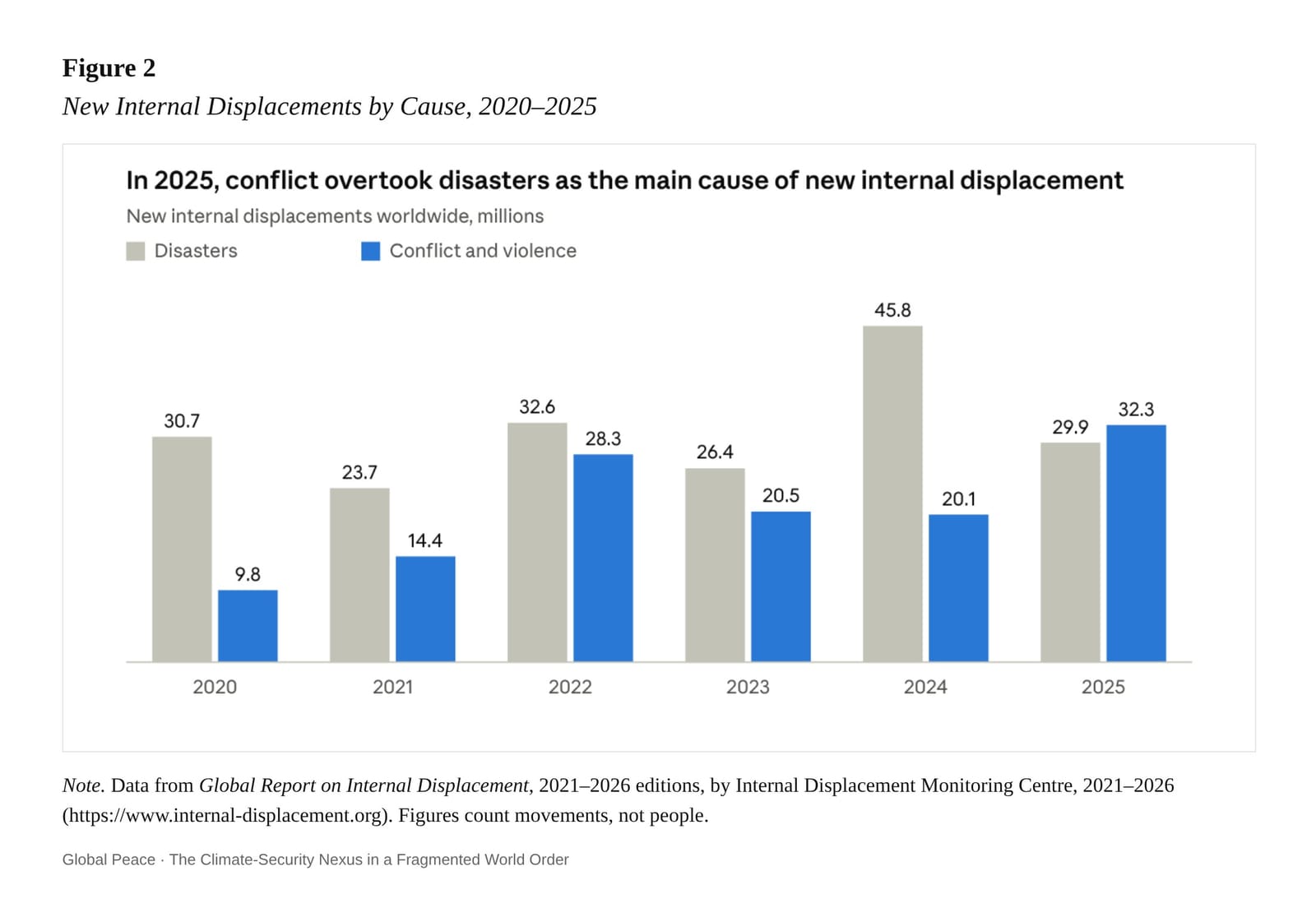
Figure 2. New internal displacements by cause, 2020–2025. Note. Data from Global Report on Internal Displacement, 2021–2026 editions, by Internal Displacement Monitoring Centre, 2021–2026 (https://www.internal-displacement.org).
Disasters drove most new displacement in five of the last six years, peaking in 2024. Conflict displacement has more than tripled since 2020, and in 2025 it took the lead for the first time.
In real life, these two causes cannot be separated. A family driven out by floods may be driven out again by fighting. A community fleeing war may settle on land that is exposed to drought. And when displaced people arrive, they place new pressure on host communities, on schools and clinics, and on scarce land and water. If that pressure is not managed fairly, it becomes the seed of the next conflict (Ide et al., 2020).
This is why climate security must be human security. The question is not only whether borders are safe. The question is whether people are safe: whether they have food, water and shelter, and whether they have a voice in the decisions that shape their lives.
A Fragmented World Order
The climate crisis has come at the worst possible time. Great-power rivalry, wars in several regions, trade disputes and falling trust in multilateral institutions are pulling the world apart. Climate change is a problem no nation can solve alone, yet the international system is dividing when it most needs to unite.
We see this division at the very top. In December 2021, a draft Security Council resolution led by Ireland and Niger, and supported by 113 member states, sought to bring climate-related security risks into the Council’s work on conflict prevention. Twelve members voted in favour. It still failed, because Russia used its veto, with India also voting against and China abstaining (Security Council Report, 2021). One voice silenced the many, on a threat that affects every nation on earth.
We see it in finance. The countries most exposed to climate insecurity are often the least responsible for emissions and the least able to pay for adaptation. Many are fragile or affected by conflict, and so investors and donors regard them as too risky. This is a cruel paradox. The places where climate action could do most to prevent conflict receive the least support.
And we see it in our priorities. When military budgets rise year after year and adaptation funding struggles to grow, the world is paying for the symptoms of insecurity instead of curing its causes.
Table 1
Annual Global Spending on Militaries, Climate Finance and the United Nations
| What the world spends | US$ billion a year | Source |
| World military expenditure, 2025 | 2,887 | SIPRI (2026) |
| New climate finance goal for developing countries, to be reached by 2035 | 300 | UNFCCC (2024) |
| UN regular budget, 2026 | 3.45 | UN News (2025b) |
Note. Data from Trends in World Military Expenditure, 2025, by Stockholm International Peace Research Institute, 2026; New Collective Quantified Goal on Climate Finance (Decision 1/CMA.6), by United Nations Framework Convention on Climate Change, 2024; and “General Assembly Approves $3.45 Billion UN Regular Budget for 2026,” by UN News, 2025b.
In other words, the world spends nearly ten times more on its militaries each year than the climate finance goal it has set for 2035, and more than 800 times the UN’s entire regular budget.
Collective Security Mechanisms: Progress and Gaps
The picture is not all bleak. Important foundations have been laid.
• The UN Climate Security Mechanism. Created in 2018 by the UN Department of Political and Peacebuilding Affairs, the UN Development Programme and the UN Environment Programme, and later joined by the Department of Peace Operations, it helps the UN system understand and respond to climate-related security risks (United Nations Climate Security Mechanism, n.d.).
• International law. In July 2025, the International Court of Justice confirmed that states have legal obligations to prevent significant harm to the climate system, and that failing to take appropriate measures may be an internationally wrongful act. The opinion is not binding, but it carries great legal and moral weight (International Court of Justice [ICJ], 2025).
• Climate finance. At COP29 in Baku, nations agreed to mobilise at least US$300 billion a year for developing countries by 2035 (United Nations Framework Convention on Climate Change [UNFCCC], 2024). At COP30 in Belém, they agreed to at least triple adaptation finance by 2035 (Carbon Brief, 2025), and a fund for responding to loss and damage is now in operation.
These are real achievements. But they share three weaknesses. They are fragmented. They are underfunded. And they are disconnected from the places where climate stress and conflict meet. Climate talks rarely speak about security, and security institutions rarely speak about climate. Too little adaptation money reaches communities affected by conflict. Above all, the people who suffer most, including women, young people, farmers, herders and Indigenous communities, are too often missing from the rooms where decisions are made.
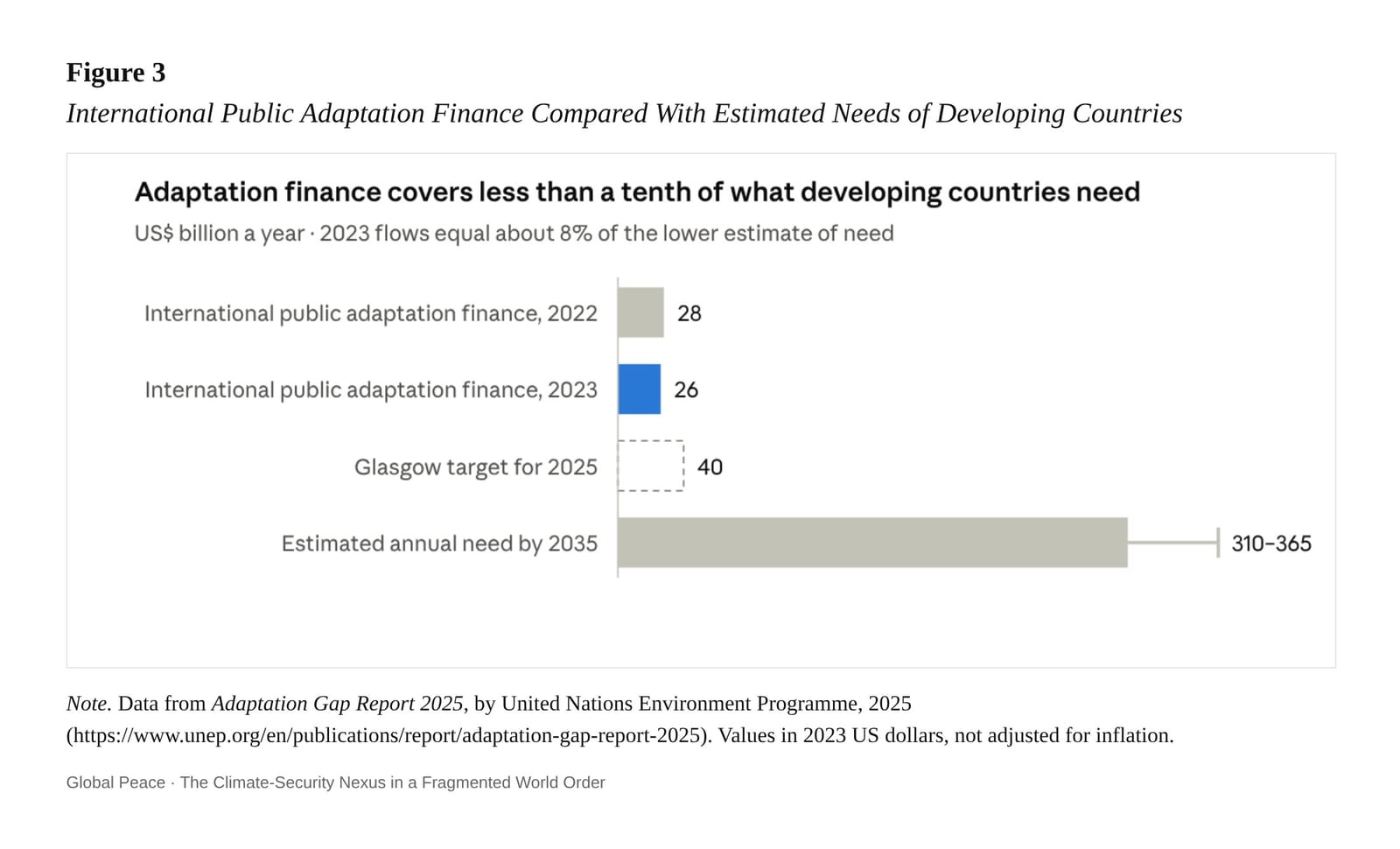
Figure 3. International public adaptation finance compared with estimated needs of developing countries. Note. Data from Adaptation Gap Report 2025, by United Nations Environment Programme, 2025 (https://www.unep.org/en/publications/report/adaptation-gap-report-2025). Values in 2023 US dollars, not adjusted for inflation.
The gap is stark. Developing countries will need between US$310 billion and US$365 billion a year for adaptation by 2035, yet international public adaptation finance fell to US$26 billion in 2023, and the Glasgow promise to double it to about US$40 billion by 2025 is unlikely to be met (United Nations Environment Programme [UNEP], 2025).
COP31 has been called the “implementation COP”. For communities living on the frontline of climate and conflict, implementation must mean more than money. It must mean institutions they can trust.
A Dialogue-Based Path Forward
The climate-security nexus proves a simple point: weapon-based security is no longer enough. What climate change demands is not more firepower but more cooperation. It demands that we learn to manage shared scarcity together. This is the heart of Asamani’s Dialogue-Based Security (DBS), which holds that security is built through institutionalised, continuous and inclusive dialogue capable of transforming the grievances that generate violence (Asamani, 2026). Its three pillars give us a practical way forward.
1. Prevention First. Climate-related conflict is among the most predictable forms of insecurity. We can see the droughts coming. We can map the communities at risk. So we must act before the violence, not after it. Climate early warning must be linked to political early response, so that a forecast of failed rains brings farmers, herders, local leaders and regional bodies to the table before disputes turn deadly. Every dollar spent on local mediation and fair resource agreements is a dollar saved on relief and reconstruction.
2. Inclusive Dialogue. Those who live with climate stress understand it best. The woman who walks further each year for water. The young person who watches his livelihood disappear. The herder who knows the old routes. The Indigenous community that has cared for the land for generations. Each must have a seat at every table, from the village council to the COP negotiating room. Africa’s traditions of the palaver, the kgotla and the indaba remind us that communities have always had ways of talking through disputes. We must strengthen these forums, and turn river and basin commissions into standing places of cooperation rather than arenas of rivalry.
3. Human Security. The true measure of climate security is not the strength of our borders but the safety of our people. Adaptation finance must reach fragile and conflict-affected communities directly. Climate action and peacebuilding must be planned together, so that a new irrigation scheme also builds trust between communities, and a tree-planting programme also gives young people work and hope. In the spirit of Ubuntu, my security is bound up with yours (Murithi, 2006).
Together, these pillars point to one principle. In a warming world, dialogue is not a luxury. It is a necessity.
Conclusion: Choosing Cooperation Over Fragmentation
Climate change is reshaping the foundations of global peace. It is deepening old conflicts, creating new pressures and exposing the cracks in a divided world order. But it also offers an opportunity. Because no nation can face this crisis alone, every nation now has a reason to talk.
We call on governments, the United Nations, regional organisations and civil society to act on four priorities:
1. Link climate early warning to early dialogue, so that predictable shocks trigger mediation, not military response.
2. Bring the most affected to the table, so that women, young people and frontline communities shape the decisions that affect their lives.
3. Direct adaptation finance to fragile and conflict-affected communities, and move a share of rising military budgets into resilience and dialogue.
4. Place climate at the heart of collective security, so that the UN system and regional bodies treat climate risk as part of their core work for peace.
The choice before us is clear. We can keep arming ourselves against a threat that weapons cannot defeat. Or we can build the institutions of dialogue that allow humanity to adapt together. Weapons can stop a battle. Only dialogue can end a war. As Global Peace has put it, “Peace is not secured by preparing for war. It is secured by preparing for dialogue” (Asamani, 2026).
References
Asamani, M. K. (2026, November 4). Global Peace calls for a shift from weapon-based security to dialogue-based security. Global Peace. https://globalpeace.me/global-peace-calls-for-a-shift-from-weapon-based-security-to-dialogue-based-security/
Barnett, J., & Adger, W. N. (2007). Climate change, human security and violent conflict. Political Geography, 26(6), 639–655. https://doi.org/10.1016/j.polgeo.2007.03.003
Benjaminsen, T. A., Alinon, K., Buhaug, H., & Buseth, J. T. (2012). Does climate change drive land-use conflicts in the Sahel? Journal of Peace Research, 49(1), 97–111. https://doi.org/10.1177/0022343311427343
Buhaug, H. (2010). Climate not to blame for African civil wars. Proceedings of the National Academy of Sciences, 107(38), 16477–16482. https://doi.org/10.1073/pnas.1005739107
Carbon Brief. (2025, November). Analysis: Why COP30’s ‘tripling adaptation finance’ target is less ambitious than it seems. https://www.carbonbrief.org/?p=60456
CNA Military Advisory Board. (2007). National security and the threat of climate change. CNA Corporation. https://www.cna.org/reports/2007/national-security-and-the-threat-of-climate-change
Dawn. (2025). What India’s Indus Waters Treaty suspension means for Pakistan. https://www.dawn.com/news/1906274
Galtung, J. (1969). Violence, peace, and peace research. Journal of Peace Research, 6(3), 167–191. https://doi.org/10.1177/002234336900600301
Hsiang, S. M., Burke, M., & Miguel, E. (2013). Quantifying the influence of climate on human conflict. Science, 341(6151), Article 1235367. https://doi.org/10.1126/science.1235367
Ide, T., Brzoska, M., Donges, J. F., & Schleussner, C.-F. (2020). Multi-method evidence for when and how climate-related disasters contribute to armed conflict risk. Global Environmental Change, 62, Article 102063. https://doi.org/10.1016/j.gloenvcha.2020.102063
Intergovernmental Panel on Climate Change. (2022). Climate change 2022: Impacts, adaptation and vulnerability. Contribution of Working Group II to the Sixth Assessment Report of the Intergovernmental Panel on Climate Change. Cambridge University Press. https://doi.org/10.1017/9781009325844
Internal Displacement Monitoring Centre. (2021). Global report on internal displacement 2021. https://www.internal-displacement.org/global-report/grid2021/
Internal Displacement Monitoring Centre. (2022). Global report on internal displacement 2022. https://www.internal-displacement.org/global-report/grid2022/
Internal Displacement Monitoring Centre. (2023). Global report on internal displacement 2023. https://www.internal-displacement.org/global-report/grid2023/
Internal Displacement Monitoring Centre. (2024). Global report on internal displacement 2024. https://www.internal-displacement.org/global-report/grid2024/
Internal Displacement Monitoring Centre. (2025). Global report on internal displacement 2025. https://www.internal-displacement.org/global-report/grid2025/
Internal Displacement Monitoring Centre. (2026). Global report on internal displacement 2026. https://www.internal-displacement.org
International Court of Justice. (2025). Obligations of States in respect of climate change (Advisory Opinion of 23 July 2025). https://www.icj-cij.org/case/187
Khaleej Times. (2026, November 9). COP31 opens with leaders told to ‘get serious’ about tackling climate crisis. https://www.khaleejtimes.com/world/cop31-opens-leaders-pressure-tackle-climate-crisis
Mach, K. J., Kraan, C. M., Adger, W. N., Buhaug, H., Burke, M., Fearon, J. D., Field, C. B., Hendrix, C. S., Maystadt, J.-F., O’Loughlin, J., Roessler, P., Scheffran, J., Schultz, K. A., & von Uexkull, N. (2019). Climate as a risk factor for armed conflict. Nature, 571(7764), 193–197. https://doi.org/10.1038/s41586-019-1300-6
Murithi, T. (2006). Practical peacemaking wisdom from Africa: Reflections on Ubuntu. Journal of Pan African Studies, 1(4), 25–34.
OECD. (2024). Climate finance provided and mobilised by developed countries in 2013–2022. OECD Publishing. https://www.oecd.org/en/about/news/press-releases/2024/05/developed-countries-materially-surpassed-their-usd-100-billion-climate-finance-commitment-in-2022-oecd.html
Okpara, U. T., Stringer, L. C., Dougill, A. J., & Bila, M. D. (2015). Conflicts about water in Lake Chad: Are environmental, vulnerability and security issues linked? Progress in Development Studies, 15(4), 308–325. https://doi.org/10.1177/1464993415592738
Pacific Islands Forum. (2018). Boe Declaration on Regional Security. https://forumsec.org
Parkinson, S., & Cottrell, L. (2022). Estimating the military’s global greenhouse gas emissions. Scientists for Global Responsibility & Conflict and Environment Observatory. https://ceobs.org/estimating-the-militarys-global-greenhouse-gas-emissions/
Peters, K., Dupar, M., Opitz-Stapleton, S., Lovell, E., Budimir, M., Brown, S., & Cao, Y. (2020). Climate change, conflict and fragility: An evidence review and recommendations for research and action. ODI. https://odi.org/en/publications/climate-change-conflict-and-fragility-an-evidence-review-and-recommendations-for-research-and-action/
Raleigh, C., & Kniveton, D. (2012). Come rain or shine: An analysis of conflict and climate variability in East Africa. Journal of Peace Research, 49(1), 51–64. https://doi.org/10.1177/0022343311427754
Rustad, S. A. (2025). Conflict trends: A global overview, 1946–2024 (PRIO Paper). Peace Research Institute Oslo. https://www.prio.org/publications/14453
Security Council Report. (2021, December). Climate change and security: Vote on a resolution. What’s In Blue. https://www.securitycouncilreport.org/whatsinblue/2021/12/climate-change-and-security-vote-on-a-resolution.php
Stockholm International Peace Research Institute. (2026). Trends in world military expenditure, 2025 (SIPRI Fact Sheet). https://www.sipri.org/publications/2026/sipri-fact-sheets/trends-world-military-expenditure-2025
United Nations. (2007, April 17). Security Council holds first-ever debate on impact of climate change on peace, security, hearing over 50 speakers (Press Release SC/9000). https://press.un.org/en/2007/sc9000.doc.htm
United Nations Climate Security Mechanism. (n.d.). About the Climate Security Mechanism. United Nations. https://www.un.org/climatesecuritymechanism/en/node/25
United Nations Development Programme. (1994). Human development report 1994. Oxford University Press.
United Nations Environment Programme. (2025). Adaptation gap report 2025. https://www.unep.org/en/publications/report/adaptation-gap-report-2025
United Nations Framework Convention on Climate Change. (2024). New collective quantified goal on climate finance (Decision 1/CMA.6). https://unfccc.int
United Nations General Assembly. (2009). Climate change and its possible security implications (A/RES/63/281).
United Nations Security Council. (2011). Statement by the President of the Security Council (S/PRST/2011/15).
United Nations Security Council. (2017). Resolution 2349 (S/RES/2349).
von Uexkull, N., Croicu, M., Fjelde, H., & Buhaug, H. (2016). Civil conflict sensitivity to growing-season drought. Proceedings of the National Academy of Sciences, 113(44), 12391–12396. https://doi.org/10.1073/pnas.1607542113
World Meteorological Organization. (2026). State of the global climate 2025. https://wmo.int