“Climate change is no longer an environmental issue on the margins of foreign policy. It has become a central security issue of the twenty-first century.”
— Kobla Asamani, Global Coordinator General, Global Peace
Introduction
For three-quarters of a century, the architecture of global peace was built to prevent wars between states. It was not designed for a crisis that respects no borders, needs no army and threatens every country at once. Today the world faces a collision of two crises: a rapidly warming planet and a fragmenting international order. Each makes the other worse.
The evidence of that collision is everywhere. In 2024, disasters triggered a record 45.8 million internal displacements, and 99.5% of them were caused by weather-related hazards (Internal Displacement Monitoring Centre [IDMC], 2025). Some 60% of the 25 countries most vulnerable to climate change are also mired in armed conflict (International Committee of the Red Cross [ICRC], 2020). Yet the communities living at this intersection receive the least support to adapt.
Global Peace has long held that peace is more than the absence of war; it is also the absence of poverty, unemployment and inequality. Climate change attacks all three at once. This article sets out the evidence linking climate and conflict, traces four pathways through which a warming world undermines peace, and proposes a climate peacebuilding agenda that treats climate action as peace action.
A Hotter, More Unstable World
The physical science is no longer in serious dispute. The World Meteorological Organization (WMO, 2025) confirmed that 2024 was the warmest year on record, at about 1.55°C above pre-industrial levels, the first calendar year above the 1.5°C threshold named in the Paris Agreement. Over the past 50 years, the number of recorded weather-, climate- and water-related disasters has increased fivefold (WMO, 2021). Current national policies put the world on course for up to 3.1°C of warming this century (United Nations Environment Programme [UNEP], 2024).
This warming coincides with the most violent period since the Second World War. Data from the Uppsala Conflict Data Program show 61 state-based armed conflicts across 36 countries in 2024, the highest number since records began in 1946, and Africa alone hosted 28 of them (Rustad, 2025). At the same time, more than 295 million people faced acute food insecurity (Food Security Information Network [FSIN], 2025), and a record 83.4 million people were living in internal displacement (IDMC, 2025).
Climate as a Threat Multiplier: What the Evidence Says
Climate change rarely starts a war on its own. Instead, it acts as a threat multiplier: it takes existing fragility, such as poverty, weak governance, ethnic tension and inequality, and makes it more dangerous.
The scientific record supports this view, with important nuance. A landmark meta-analysis of 60 studies found that each standard-deviation shift toward warmer temperatures or more extreme rainfall raised the frequency of interpersonal violence by about 4% and intergroup conflict by about 14% (Hsiang et al., 2013). The Intergovernmental Panel on Climate Change (IPCC) later concluded with medium confidence that climate extremes are associated with more conflict, especially low-intensity organised violence, and that the link is strongest where populations are poor, politically marginalised and dependent on agriculture (O’Neill et al., 2022). It also warned that, at higher levels of warming, extremes will increasingly affect violent intrastate conflict (IPCC, 2022).
Research on disasters points the same way. A multi-method study found that climate-related disasters raise the risk of armed conflict mainly in countries with large populations, political exclusion of ethnic groups and low human development (Ide et al., 2020). In other words, climate is a powerful amplifier, but politics decides whether stress turns into violence.
The relationship also runs in both directions. War destroys the institutions, infrastructure and social trust that communities need to cope with droughts and floods, leaving them more exposed to the next shock (Buhaug & von Uexkull, 2021). Conflict-affected countries are not more vulnerable simply because of geography; war has hollowed out their capacity to adapt (ICRC, 2020). The result is a vicious circle in which each crisis deepens the other.
Four Pathways from Climate Stress to Insecurity
Pathway 1: The shrinking commons
The resources communities share are shrinking. Lake Chad has lost roughly 90% of its surface since the 1960s (UNEP, 2018), and 80–90% of people in its basin depend on farming, herding and fishing (Wilson Center, n.d.). As livelihoods collapsed, Boko Haram and the Islamic State West Africa Province exploited poverty, youth unemployment and distrust of the state to recruit fighters. Twelve of the world’s 17 most water-stressed countries are in the Middle East and North Africa (Hofste et al., 2019). The Sahara itself expanded by about 10% over the twentieth century (Thomas & Nigam, 2018).
As pasture and water shrink, competition sharpens. In Nigeria’s Middle Belt, farmer-herder violence killed more than 1,300 people in the first half of 2018 alone (International Crisis Group, 2018). UNEP (2009) found that at least 40% of intrastate conflicts over six decades have been linked to natural resources, and that such conflicts are twice as likely to relapse within five years. Scarcity does not automatically cause conflict, but it creates a market for those who promise survival.
Hunger is the clearest symptom. In 2024, weather extremes were the main driver of acute food insecurity for over 96 million people in 18 countries, second only to conflict (FSIN, 2025).
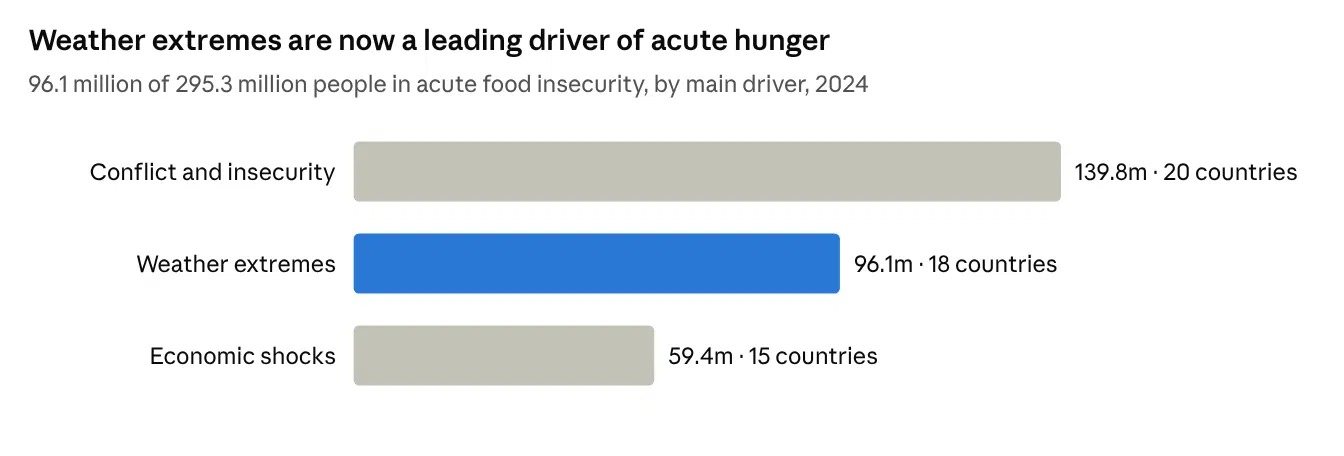
Source: Global Report on Food Crises 2025 (FSIN, 2025)
Pathway 2: Displacement, when home is no longer habitable
When livelihoods collapse, people move. Most move within their own countries, from rural areas to fast-growing cities such as Lagos, Dhaka and Karachi that lack the housing, jobs and services to absorb them. The World Bank projects that climate change could force up to 216 million people to migrate internally by 2050, including 86 million in sub-Saharan Africa (Clement et al., 2021). The Institute for Economics and Peace (IEP, 2020) puts the upper-end risk far higher, estimating that up to 1.2 billion people could be displaced by ecological threats by 2050.
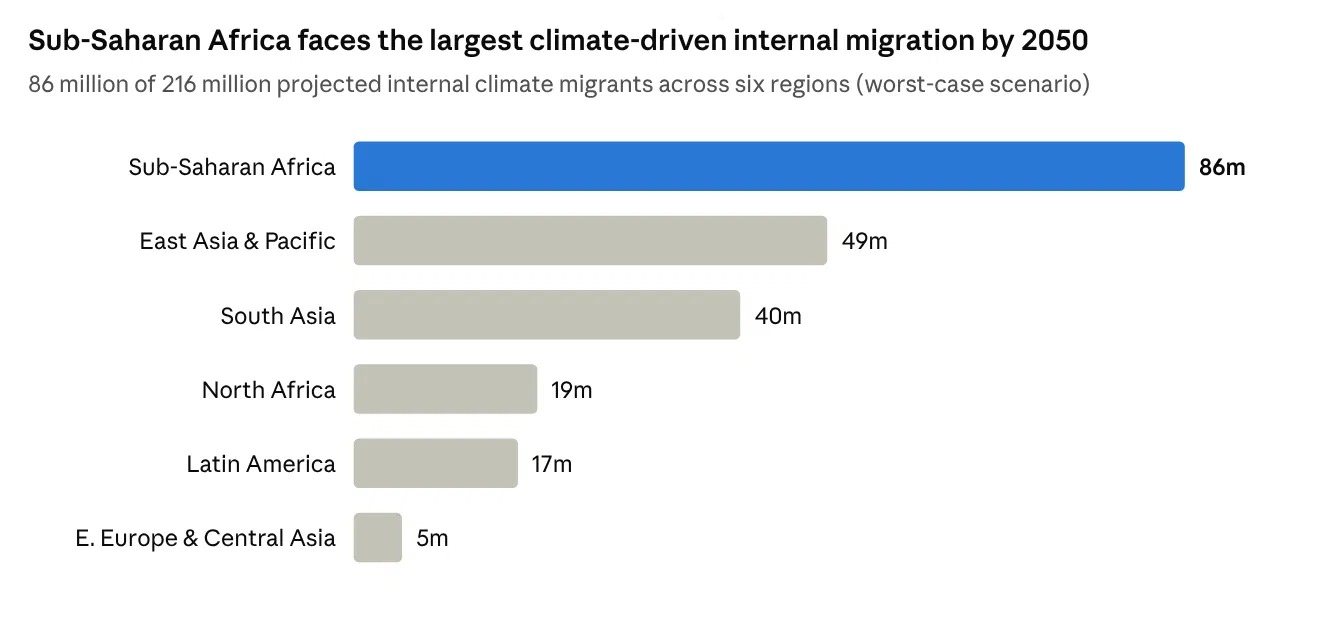
Source: World Bank Groundswell report (Clement et al., 2021)
In Central America’s Dry Corridor, repeated droughts have destroyed maize and bean harvests, and the World Food Programme (2017) found a clear link between food insecurity and emigration from El Salvador, Guatemala and Honduras, where hunger compounds gang violence. Unplanned displacement strains host communities and can become a driver of unrest where governance is weak.
Pathway 3: The fragility trap
A strong state can manage a disaster; a fragile one can be broken by it. Syria’s 2007–2010 drought was the worst in its instrumental record and pushed as many as 1.5 million people from farms to crowded city outskirts before the 2011 uprising. Human-caused warming made a drought of that severity two to three times more likely (Kelley et al., 2015). Climate did not cause the war, but it deepened the pressures that preceded it.
Pakistan’s 2022 floods affected 33 million people, killed more than 1,730 and caused over US$30 billion in damage and losses, threatening to push up to 9.1 million more people into poverty (World Bank, 2022). For Pacific island states the threat is existential: in the 2018 Boe Declaration, regional leaders named climate change the single greatest threat to their peoples’ livelihoods, security and wellbeing (Pacific Islands Forum, 2018).
Pathway 4: The new geopolitics of green
The transition away from fossil fuels is essential for long-term peace, but it is creating fierce new competition. Clean energy depends on critical minerals such as lithium, cobalt, nickel, graphite and rare earths. Supply is highly concentrated: China is the leading refiner of 19 of the 20 energy-related minerals the International Energy Agency (IEA, 2025) tracks, with an average market share of around 70%, and the Democratic Republic of the Congo dominates cobalt mining.
Without fair rules on extraction, transparency and benefit-sharing, the world risks replacing oil conflicts with mineral conflicts, and mining communities in fragile states risk bearing the costs while others capture the gains.
From National Security to Human and Planetary Security
This crisis is changing how security itself is defined. Traditional national security asks how a state protects its borders from other states. Climate security asks how people are protected, regardless of borders, from a shared threat. Scholars have long argued that climate change undermines human security by eroding livelihoods and the capacity of states to provide for their citizens, which in turn raises the risk of violence (Barnett & Adger, 2007). Security now includes whether harvests survive, whether rivers still flow, whether heat is survivable and whether a community, island or culture will continue to exist.
Institutions are adapting, unevenly. In 2017, UN Security Council Resolution 2349 recognised the role of climate change in the Lake Chad Basin crisis (United Nations Security Council, 2017). NATO’s (2022) Strategic Concept names climate change a defining challenge with a profound impact on allied security. The UN Climate Security Mechanism now deploys climate, peace and security advisers to missions and regional bodies from Somalia and South Sudan to the African Union and the Lake Chad Basin Commission (UN Climate Security Mechanism, 2025). The African Union Peace and Security Council, describing climate change as a threat multiplier, has called for a Common African Position on climate, peace and security to be finalised in 2026 (African Union Peace and Security Council, 2026).
Yet geopolitics still blocks a global response. In December 2021, a draft Security Council resolution on climate-related security risks won 12 of 15 votes but was vetoed by Russia, with India voting against and China abstaining (Lederer, 2021).
There is also a danger in the security framing. Treating climate as a security threat must not simply mean sending soldiers to deal with it. Armies cannot stop sea-level rise or restore a degraded rangeland. The IPCC warns that poorly designed or inequitable climate responses can themselves drive violence (IPCC, 2022). What is needed is development, diplomacy and peacebuilding, not only defence.
The Adaptation Gap Is a Peace Gap
If climate stress fuels insecurity, adaptation is a form of conflict prevention. Yet the world is badly underinvesting in it. Developing countries will need US$310–365 billion a year for adaptation by 2035, while international public adaptation finance fell to just US$26 billion in 2023, a gap of 12 to 14 times current flows (UNEP, 2025).
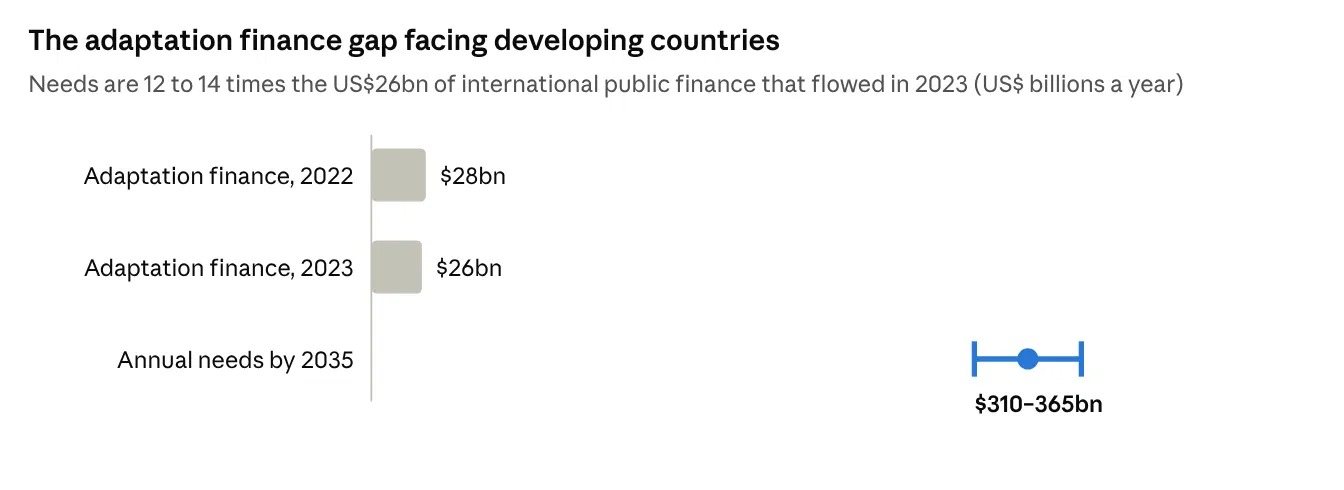
Source: Adaptation Gap Report 2025 (UNEP, 2025)
The injustice is sharpest where peace is most fragile. Sixteen conflict-affected, climate-vulnerable countries account for less than 3% of global emissions but host 44% of the world’s people in extreme poverty and over 70% of internal displacement, yet they receive about one-third of the adaptation funding per person that other countries receive (International Rescue Committee [IRC], 2023). Donors often see these settings as too risky, so the communities most exposed to both climate shocks and violence are left behind.
Trust has suffered too. Developed countries’ pledge to mobilise US$100 billion a year in climate finance for developing countries by 2020 was met only in 2022, two years late (Organisation for Economic Co-operation and Development [OECD], 2024).
The economic case for closing the gap is strong. The Global Commission on Adaptation (2019) found that investing US$1.8 trillion in five areas, including early warning systems, resilient infrastructure and dryland agriculture, could yield US$7.1 trillion in net benefits, with benefit-cost ratios of 2:1 to 10:1. Once the avoided costs of conflict, displacement and humanitarian response are added, the peace dividend of adaptation is larger still.
A Climate Peacebuilding Agenda
There can be no lasting peace on a degraded planet, and no saving the planet without peace. That is why Global Peace advocates climate peacebuilding: an integrated agenda that treats climate action as peace action. It rests on four pillars.
1. Prevention first
Early warning works when it triggers early action. Integrated systems that combine climate forecasts with conflict analysis allow governments and communities to act before a drought becomes displacement and a grievance becomes violence. A forecast of failed rains should release funds for mediation, water-sharing arrangements and livelihood support, not only humanitarian aid after people are already fighting.
2. Finance peace like we finance security
Adaptation finance for water systems, drought-resistant crops and resilient infrastructure in fragile states should be recognised as an investment in peace and security. At COP28, 74 countries and 40 organisations endorsed the Declaration on Climate, Relief, Recovery and Peace, pledging to scale up finance for fragile and conflict-affected settings (COP28 UAE Presidency, 2023). Turning that pledge into practice means climate funds and development banks accepting smarter risk, channelling money to local actors and measuring success partly by whether projects reduce tension.
3. Build cooperation around shared resources
Shared environmental challenges can become opportunities for peace. The IPCC found with high confidence that formal institutions for managing natural resources contribute to wider cooperation and peacebuilding (IPCC, 2022). Closer to home, the Volta Basin Authority brings together Benin, Burkina Faso, Côte d’Ivoire, Ghana, Mali and Togo to share river data, warn communities of floods and agree common rules for water use, easing tensions before crises arise (Graphic Online, n.d.). Peace processes should learn from this: fewer than a quarter of peace agreements for resource-linked conflicts address resource management at all (UNEP, 2009).
4. Centre justice and young people
A durable peace must be a just peace. That means delivering on loss and damage funding, ensuring a fair transition for workers and communities that depend on fossil fuels, and making sure that those most affected have a seat at the table. Young people in Africa and elsewhere are the most exposed to climate-driven unemployment and to recruitment by armed groups, yet they are also the innovators and implementers of solutions. They need a real voice where climate and security decisions are made.
Conclusion
The story of climate and peace is often told as a story of doom: inevitable wars over water and inevitable chaos. That is not the full story. The evidence shows that climate change multiplies risk, but that politics, institutions and choices decide whether stress becomes violence.
Climate change is a stress test for humanity’s ability to cooperate. It forces us to recognise that our security is shared. A farmer in northern Ghana, a fisher in Bangladesh and a family on a Pacific atoll are connected by the same crisis.
Peace is more than the absence of war. In a warming world, it also means the presence of resilience: functioning institutions, fair access to resources and communities able to withstand the next shock. Building that peace is the defining task of our time.
References
African Union Peace and Security Council. (2026, February 19). Communiqué adopted at its 1331st meeting on climate, peace and security (PSC/PR/COMM.1331 (2026)). African Union. https://amaniafrica-et.org/wp-content/uploads/1331.comm\_en.pdf
Barnett, J., & Adger, W. N. (2007). Climate change, human security and violent conflict. Political Geography, 26(6), 639–655. https://doi.org/10.1016/j.polgeo.2007.03.003
Buhaug, H., & von Uexkull, N. (2021). Vicious circles: Violence, vulnerability, and climate change. Annual Review of Environment and Resources, 46, 545–568. https://doi.org/10.1146/annurev-environ-012220-014708
Clement, V., Rigaud, K. K., de Sherbinin, A., Jones, B., Adamo, S., Schewe, J., Sadiq, N., & Shabahat, E. (2021). Groundswell part 2: Acting on internal climate migration. World Bank. https://hdl.handle.net/10986/36248
COP28 UAE Presidency. (2023). COP28 declaration on climate, relief, recovery and peace. United Nations Climate Security Mechanism. https://www.un.org/climatesecuritymechanism/sites/default/files/2025-06/COP28%20Declaration%20on%20Climate%20Relief%20Recovery%20and%20Peace.pdf
Food Security Information Network. (2025). Global report on food crises 2025. Global Network Against Food Crises. https://www.preventionweb.net/publication/global-report-food-crises-2025
Global Commission on Adaptation. (2019). Adapt now: A global call for leadership on climate resilience. Global Center on Adaptation & World Resources Institute. https://gca.org/reports/adapt-now-a-global-call-for-leadership-on-climate-resilience/
Graphic Online. (n.d.). Volta’s quiet success vs Nile’s noisy stand-off: What Ghana can teach about transboundary water. https://www.graphic.com.gh/features/opinion/ghana-news-voltas-quiet-success-vs-niles-noisy-stand-off-what-ghana-can-teach-about-transboundary-water.html
Hofste, R. W., Reig, P., & Schleifer, L. (2019, August 6). 17 countries, home to one-quarter of the world’s population, face extremely high water stress. World Resources Institute. https://www.wri.org/insights/17-countries-home-one-quarter-worlds-population-face-extremely-high-water-stress
Hsiang, S. M., Burke, M., & Miguel, E. (2013). Quantifying the influence of climate on human conflict. Science, 341(6151), Article 1235367. https://doi.org/10.1126/science.1235367
Ide, T., Brzoska, M., Donges, J. F., & Schleussner, C.-F. (2020). Multi-method evidence for when and how climate-related disasters contribute to armed conflict risk. Global Environmental Change, 62, Article 102063. https://doi.org/10.1016/j.gloenvcha.2020.102063
Institute for Economics and Peace. (2020). Ecological threat register 2020: Understanding ecological threats, resilience and peace.
Intergovernmental Panel on Climate Change. (2022). Summary for policymakers. In H.-O. Pörtner, D. C. Roberts, M. Tignor, E. S. Poloczanska, K. Mintenbeck, A. Alegría, M. Craig, S. Langsdorf, S. Löschke, V. Möller, A. Okem, & B. Rama (Eds.), Climate change 2022: Impacts, adaptation and vulnerability. Contribution of Working Group II to the Sixth Assessment Report of the Intergovernmental Panel on Climate Change (pp. 3–33). Cambridge University Press. https://doi.org/10.1017/9781009325844.001
Internal Displacement Monitoring Centre. (2025). Global report on internal displacement 2025. https://doi.org/10.55363/IDMC.XTGW2833
International Committee of the Red Cross. (2020). Seven things you need to know about climate change and conflict. https://www.icrc.org/en/document/climate-change-and-conflict
International Crisis Group. (2018). Stopping Nigeria’s spiralling farmer-herder violence (Africa Report No. 262). https://www.crisisgroup.org/africa/west-africa/nigeria/262-stopping-nigerias-spiralling-farmer-herder-violence
International Energy Agency. (2025). Global critical minerals outlook 2025. https://www.iea.org/reports/global-critical-minerals-outlook-2025
International Rescue Committee. (2023, November 14). IRC: How COP28 can address injustices facing countries at the epicenter of crisis [Press release]. https://www.rescue.org/press-release/irc-how-cop28-can-address-injustices-facing-countries-epicenter-crisis
Kelley, C. P., Mohtadi, S., Cane, M. A., Seager, R., & Kushnir, Y. (2015). Climate change in the Fertile Crescent and implications of the recent Syrian drought. Proceedings of the National Academy of Sciences, 112(11), 3241–3246. https://doi.org/10.1073/pnas.1421533112
Lederer, E. M. (2021, December 13). Russia vetoes U.N. resolution linking climate change to international security. PBS NewsHour. https://www.pbs.org/newshour/world/russia-vetoes-u-n-resolution-linking-climate-change-to-international-security
North Atlantic Treaty Organization. (2022). NATO 2022 strategic concept. https://www.nato.int/strategic-concept/
O’Neill, B., van Aalst, M., Zaiton Ibrahim, Z., Berrang Ford, L., Bhadwal, S., Buhaug, H., Diaz, D., Frieler, K., Garschagen, M., Magnan, A., Midgley, G., Mirzabaev, A., Thomas, A., & Warren, R. (2022). Key risks across sectors and regions. In H.-O. Pörtner et al. (Eds.), Climate change 2022: Impacts, adaptation and vulnerability (pp. 2411–2538). Cambridge University Press. https://doi.org/10.1017/9781009325844.025
Organisation for Economic Co-operation and Development. (2024). Climate finance provided and mobilised by developed countries in 2013–2022. OECD Publishing.
Pacific Islands Forum. (2018). Boe declaration on regional security. Pacific Islands Forum Secretariat. https://www.forumsec.org/sites/default/files/2024-03/2018%20Boe%20Declaration.pdf
Rustad, S. A. (2025). Conflict trends: A global overview, 1946–2024 (PRIO Paper). Peace Research Institute Oslo. https://www.prio.org/publications/14453
Thomas, N., & Nigam, S. (2018). Twentieth-century climate change over Africa: Seasonal hydroclimate trends and Sahara Desert expansion. Journal of Climate, 31(9), 3349–3370. https://doi.org/10.1175/JCLI-D-17-0187.1
United Nations Climate Security Mechanism. (2025). Support to analysis and action. United Nations. https://www.un.org/climatesecuritymechanism/en/node/89
United Nations Environment Programme. (2009). From conflict to peacebuilding: The role of natural resources and the environment.
United Nations Environment Programme. (2018). The tale of a disappearing lake. https://www.unep.org/node/21096
United Nations Environment Programme. (2024). Emissions gap report 2024: No more hot air… please!
United Nations Environment Programme. (2025). Adaptation gap report 2025: Running on empty. https://www.unep.org/resources/adaptation-gap-report-2025
United Nations Security Council. (2017). Resolution 2349 (2017) (S/RES/2349). https://undocs.org/S/RES/2349(2017)
Wilson Center. (n.d.). Climate change and violent extremism in the Lake Chad Basin: Key issues and way forward. https://www.wilsoncenter.org/sites/default/files/media/uploads/documents/Climate%20Change%20and%20Violent%20Extremism%20in%20the%20Lake%20Chad%20Basin%20Key%20Issues%20and%20Way%20Forward\_0.pdf
World Bank. (2022, October 28). Pakistan: Flood damages and economic losses over USD 30 billion and reconstruction needs over USD 16 billion – new assessment [Press release]. https://www.worldbank.org/en/news/press-release/2022/10/28/pakistan-flood-damages-and-economic-losses-over-usd-30-billion-and-reconstruction-needs-over-usd-16-billion-new-assessme
World Food Programme. (2017). Food security and emigration: Why people flee and the impact on family members left behind in El Salvador, Guatemala and Honduras.
World Meteorological Organization. (2021). WMO atlas of mortality and economic losses from weather, climate and water extremes (1970–2019) (WMO-No. 1267).
World Meteorological Organization. (2025). State of the global climate 2024.