Inspired by Nature — For Climate, For Our Future
For centuries, we have defined peace as the absence of war between nations. Treaties were signed, borders respected, armies withdrawn. But in the 21st century, humanity faces a new kind of conflict not between peoples, but between humanity and the planetary systems that sustain life itself.
Climate change is not just an environmental crisis. It is the ultimate peace and security challenge of our time. And the Paris Agreement may be the most important peace agreement ever written.
Climate Change: The Great Destabilizer
Science is unequivocal. The UNEP Adaptation Gap Report 2024 warns that climate risks are outpacing adaptation efforts worldwide. Global temperatures are edging toward 1.5°C, and with each fraction of a degree, the foundations of peace erode (UNEP, 2024).
When drought persists in the Horn of Africa, pastoralists and farmers clash over vanishing water. When sea levels rise in the Pacific, entire island nations face existential displacement. When harvests fail in South Asia, food prices spike and social unrest follows. Climate change does not start wars directly, but it is a threat multiplier; it multiplies hunger, inequality, migration, and desperation (UN, 2023).
True global peace can no longer be secured by military means alone. It must be secured by ecological stability.
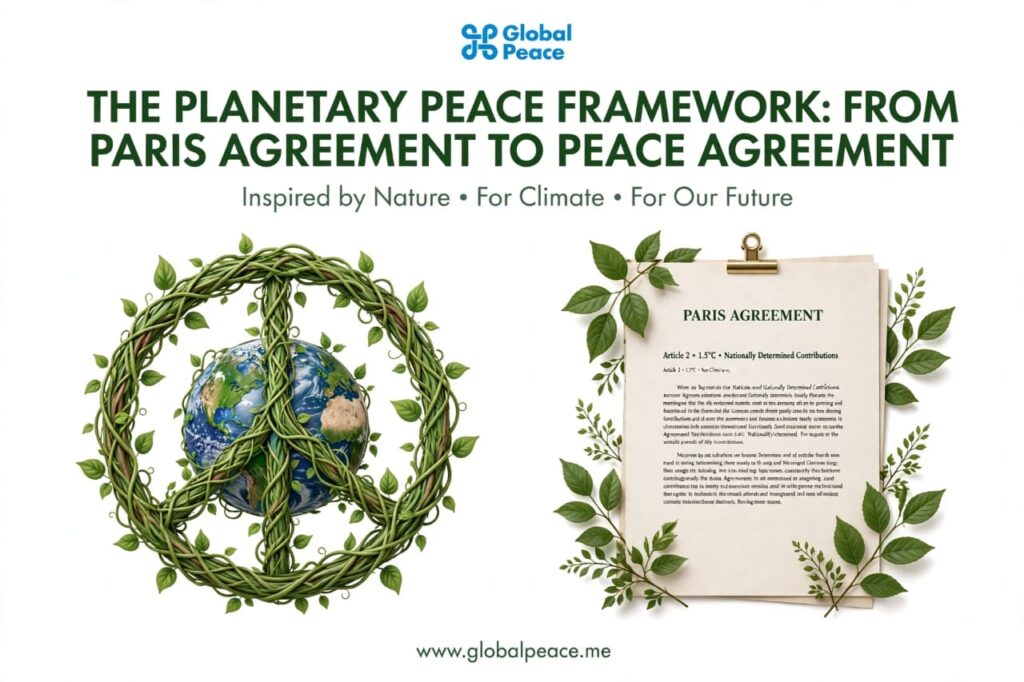
From Paris to Peace: A New Security Doctrine
Adopted in 2015, the Paris Agreement aimed to keep warming well below 2°C. But its deeper significance is political: for the first time, 196 Parties agreed that their collective security depends on protecting a shared system, the climate.
This is revolutionary. Traditional peace treaties divide resources. The Paris Agreement protects a common resource. It says: My safety depends on your action. Your future depends on my restraint.
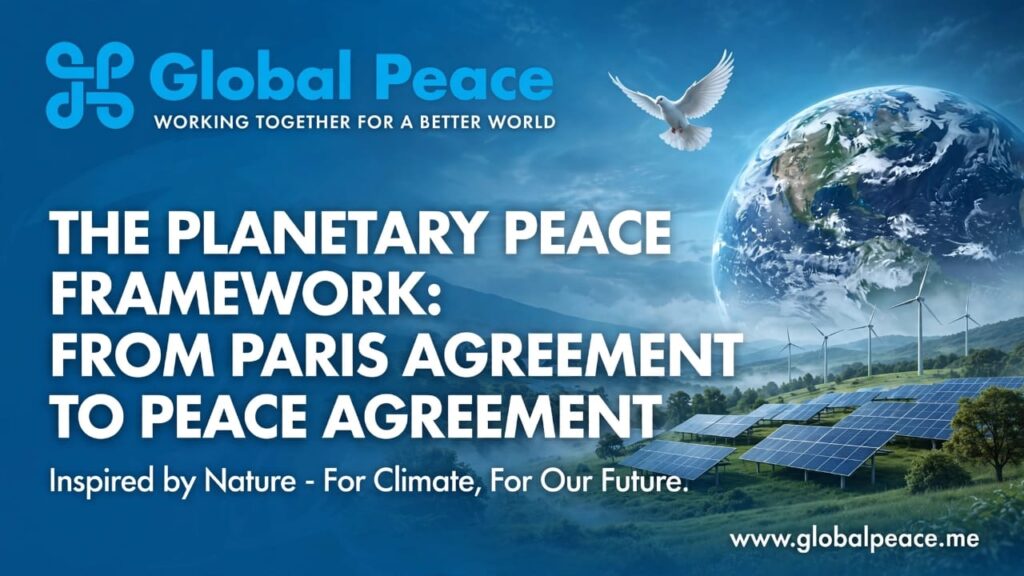
At Global Peace, we call this the Planetary Peace Framework. It rests on three pillars:
Pillar 1: Collective Security through Decarbonisation. Every tonne of carbon not emitted is a brick in the wall of global stability.
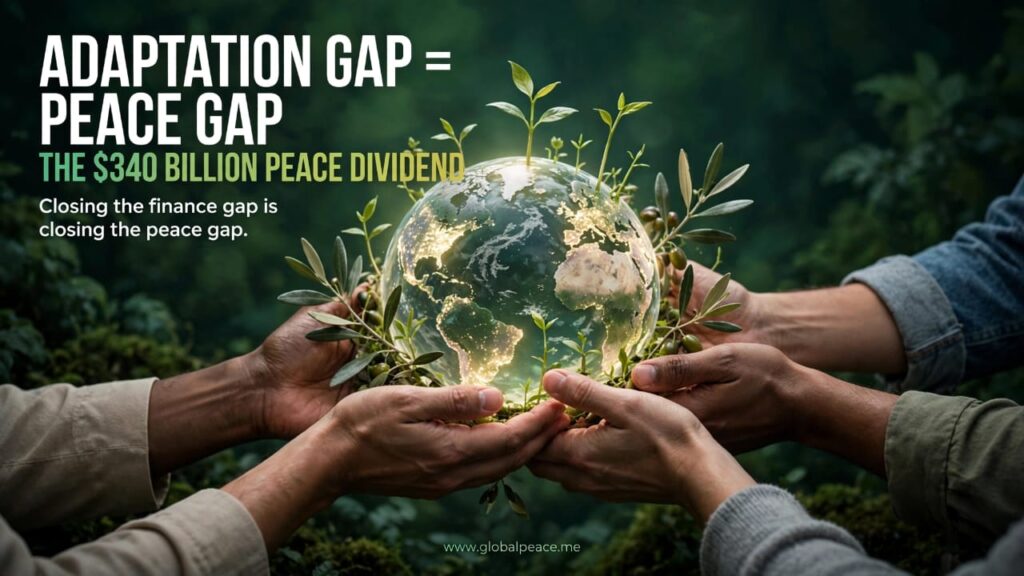
Pillar 2: Resilience through Adaptation. The adaptation gap is a peace gap. According to UNEP (2024), international public adaptation finance fell to US$26 billion in 2023, down from US$28 billion, while developing countries will need US$310 – 365 billion annually by 2035. That gap is not just financial, it is a vulnerability that can turn a drought into famine, a flood into conflict. Funding adaptation is funding peace.
Pillar 3: Restoration through Nature. Nature is not just a victim; it is a peacemaker. A mangrove forest protects a coastal village from storm surge. A restored watershed prevents conflict over water. Inspired by Nature is not a slogan, it is a strategy for survival.
Nature as the Original Peacemaker
Nature-based solutions can provide up to 37% of the mitigation needed to meet Paris goals while building resilience (Griscom et al., 2017). In Ghana, where Global Peace is rooted, restoring degraded cocoa landscapes with agroforestry brings farmers higher income and climate resilience.
Environment in War, War in Environment
On 6 November each year, we mark the International Day for Preventing the Exploitation of the Environment in War and Armed Conflict. War destroys the very ecosystems climate action depends on.
Military emissions themselves remain largely unaccounted for in climate pledges. Recent research estimates that militaries and their supply chains account for approximately 5.5% of global greenhouse gas emissions, which would make them the world’s fourth-largest emitter if counted as a country (Conflict and Environment Observatory, 2022; Parkinson & Cottrell, 2022).
If we are serious about a planetary peace framework, we must recognize that demilitarization and decarbonisation are two sides of the same coin.
A bomb that destroys a forest releases carbon and destroys a carbon sink. Peace that allows a forest to regrow is climate action.
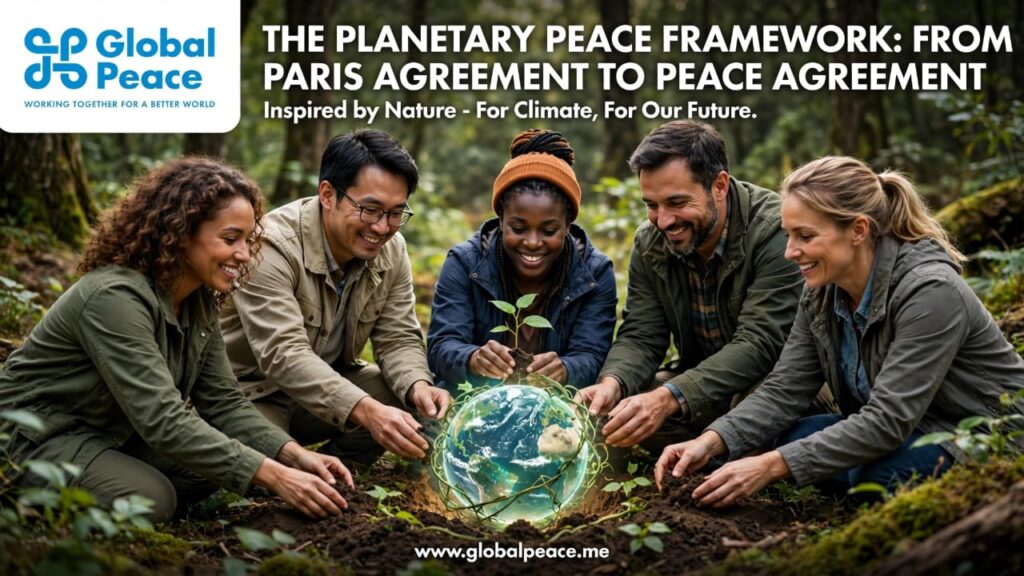
The Working Together Imperative
No country can adapt alone. No country can decarbonize alone. The atmosphere does not carry a passport.
This is why our motto at Global Peace: working together for a Better World is not idealism. It is realism for the climate era.
Working together means:
- Rich nations fulfilling adaptation finance pledges, not as aid but as shared security investment.
- Technology transfer for clean energy and early warning systems.
- Youth-led restoration movements connected globally through www.globalpeace.me.
- Cities sharing solutions; Inspired by Nature.
The World Environment Day theme For Climate, For Our Future reminds us that that future must be peaceful.
A Peace Treaty with the Planet
The Paris Agreement is imperfect. Implementation is slow. The Emissions Gap and Adaptation Gap remain dangerously wide. But it contains a profound truth: in the Anthropocene, peace with each other requires peace with the planet.
We need a new definition of global peace one that includes stable climate, healthy ecosystems, equitable adaptation, and justice for the most vulnerable. The planet has offered us a peace treaty. It is written in the rings of trees, the flow of rivers, and the resilience of mangroves. Our task is to sign it.
References
Conflict and Environment Observatory. (2022). The military’s climate impact. https://ceobs.org
Griscom, B. W., et al. (2017). Natural climate solutions. Proceedings of the National Academy of Sciences, 114 (44), 11645–11650. https://doi.org/10.1073/pnas.1710465114
Parkinson, S., & Cottrell, L. (2022). Estimating the military’s global greenhouse gas emissions. Scientists for Global Responsibility.
United Nations. (2023). A new agenda for peace (Policy Brief No. 9).
United Nations Environment Programme. (2024). Adaptation gap report 2024: Come hell and high water. UNEP.