The Future of Global Peace: Why Resilience Must Replace Deterrence
By Mawuli Kobla Asamani, Global Coordinator General, Global Peace
The peace paradox
The world has never spent more on security, yet it has rarely felt less secure. In 2025, governments spent a record US$2.887 trillion on their militaries. It was the eleventh consecutive annual rise, and it lifted the global military burden to 2.5% of world GDP, the highest since 2009 (SIPRI).
Over the same year, the Uppsala Conflict Data Program recorded 65 state-based armed conflicts, the most since records began in 1946. Wars between states doubled for the second year running. The Global Peace Index reports twelve straight years of declining peacefulness, with the economic impact of violence reaching US$21.81 trillion, about 10.5% of global GDP.
More weapons, more alliances and more deterrent capability have come with more war, not less. Deterrence still matters between nuclear-armed rivals. But it was never built to stop a civil war fuelled by exclusion, a drought that turns herders against farmers, or a government that pays more in interest than it spends on health. Most of today’s wars are fought inside states, drawn in by outside sponsors and sustained by grievances no missile can deter.
My argument is simple. In a divided world order, peace can no longer rest mainly on deterrence and on deals struck among a few powerful states. It must be rebuilt on resilience: legitimate institutions, fair access to the things that make life secure, and communities able to absorb shocks without turning to violence.
Three fault lines
Today’s insecurity runs along three divisions at once: geopolitical, economic and climatic. The Institute for Economics and Peace calls the result a “great fragmentation” of the international system.
The geopolitical division. The hope of a rules-based order run by a cooperative Security Council has collapsed. Permanent members are now parties to, or sponsors of, active wars, from Ukraine to the Middle East. Interstate conflicts rose from two in 2023 to eight in 2025. The number of countries involved in some external conflict has almost doubled since 2008, from 59 to 103, and internationalised civil wars have risen 175% since 2010. Wars are also harder to end: only about 4% of conflicts in the last decade closed with a peace agreement, against 23% in the 1970s.
The economic division. Global public debt hit a record US$102 trillion in 2024, US$31 trillion of it owed by developing countries, whose net interest bill rose to US$921 billion (UNCTAD). Some 3.4 billion people now live in countries that spend more on interest than on health or education. At the same time, aid from OECD donors fell 23.1% in 2025 to US$174.3 billion, the steepest drop ever recorded, and humanitarian aid fell by almost 36%. In the Sahel, the Horn of Africa or Central America, this decides whether a clinic stays open, teachers are paid, and young men find a job or a recruiter.
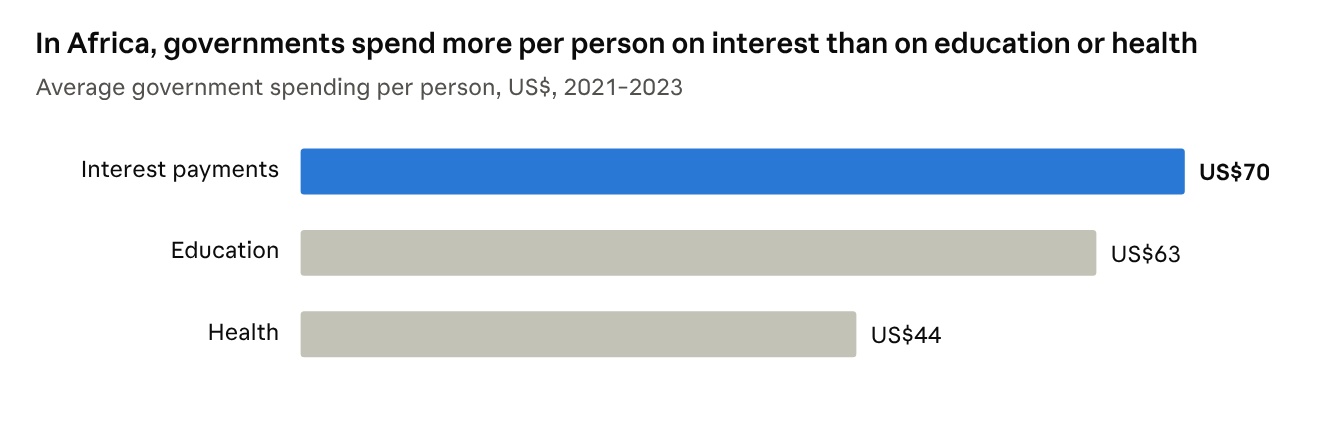
Source: UNCTAD, A World of Debt 2025 · Africa, 2021–2023 average
The climate division. Disasters triggered a record 45.8 million internal displacements in 2024. By the end of 2025, 82.2 million people were internally displaced across 104 countries and territories (IDMC). Climate rarely causes war alone, but it multiplies existing stress: shrinking water around Lake Chad, failed harvests in the Sahel, floods in South Asian cities whose governments are already squeezed by debt.
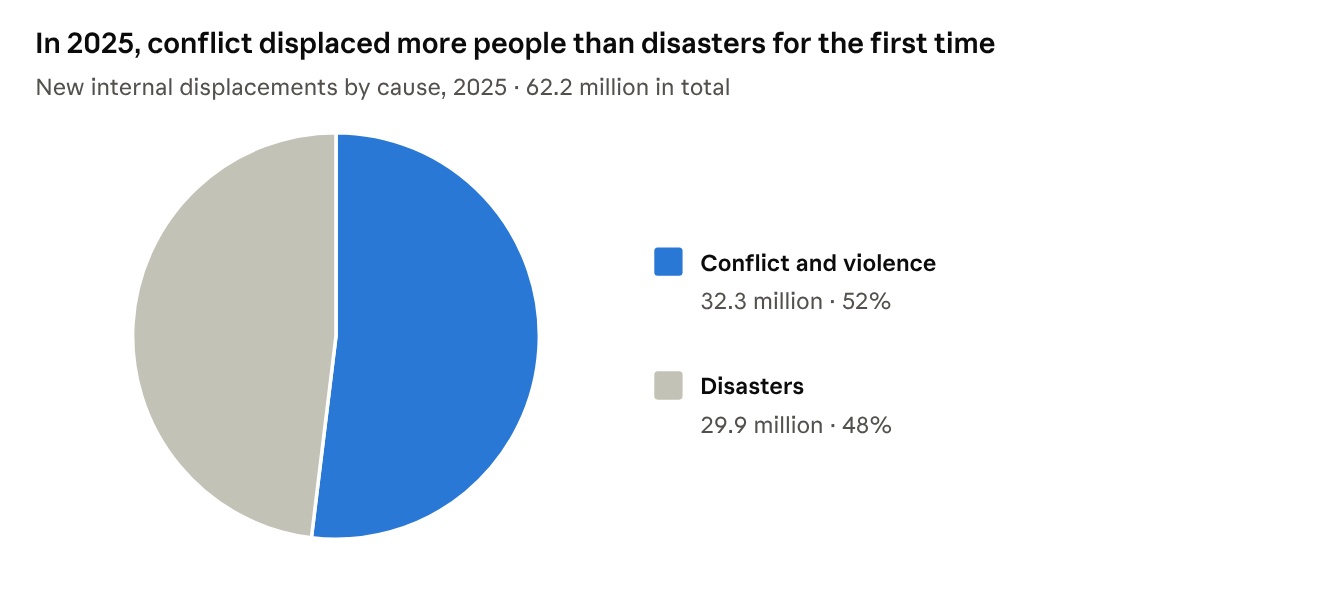
Source: IDMC, Global Report on Internal Displacement 2026
These divisions feed each other. In Sudan, a war between rival forces, sustained by outside sponsors and gold, has killed an estimated 150,000 people and displaced more than 12 million, while famine has been confirmed in several regions. Rivalry supplies the weapons, debt and aid cuts remove the means to respond, and climate stress deepens the hunger. A strategy that treats these as separate files will keep failing.
Why the old tools are failing
The three classic tools of peace — UN peacekeeping, treaties and great-power deterrence — were designed for interstate wars and a Security Council that could agree. Each still has value, but each is now underfunded, outpaced or misapplied.
Peacekeeping is being starved. Research shows that well-resourced UN missions reduce battle deaths and shorten wars. Yet the 2025–26 budget of US$5.38 billion carries a shortfall of roughly US$2 billion in unpaid contributions. Missions have been told to cut spending by 15% and send home a quarter of their uniformed personnel. Host governments, as in Mali, have withdrawn consent. Drawdowns without a plan leave vacuums that armed groups fill.
The treaty web is thinning. The INF Treaty collapsed in 2019. When New START expired on 5 February 2026, the United States and Russia were left without binding limits on strategic nuclear forces for the first time since the early 1970s. Where peace deals are signed, they are often elite bargains that exclude women, youth and the communities who must live with them, so they rarely last.
Deterrence is necessary but not sufficient. It does little against non-state actors: drone attacks rose by more than 11,500% between 2018 and 2025, carried out by 565 armed groups. It feeds a security dilemma in which one state’s defence looks like another’s threat. Above all, it consumes the money prevention needs. Global spending on peacebuilding equals just 0.52% of military spending. In 2025 the UN Peacebuilding Fund approved about US$124 million, far below the US$500 million a year the Secretary-General has asked for.
The common root is that these tools treat peace as the absence of war between organised forces, secured from the top and from outside. Today’s conflicts grow from the inside out. An order built to freeze front lines cannot fix the conditions that keep producing them.
Peace as resilience
Deterrence asks, “How do we make attack too costly?” Resilience asks, “How do we make violence unnecessary and unrewarding?” The second question is the one most of today’s conflicts pose.
The idea builds on Johan Galtung’s distinction between negative peace, the absence of violence, and positive peace, the presence of justice, fair institutions and basic needs met. The UN adopted similar thinking in its 2016 “sustaining peace” resolutions. What is new is the urgency: when debt, climate and rivalry strike together, a society’s capacity to absorb a shock decides whether a crisis becomes a war. Resilient peace rests on three pillars.
1. Resilience. This is the capacity to absorb a failed harvest, a disputed election or a currency crisis without mass violence. The UN–World Bank study Pathways for Peace estimated that scaled-up prevention could save between US$5 billion and US$70 billion a year. Bangladesh shows what local capacity can do: early warning, shelters and community volunteers cut cyclone deaths from about 500,000 in 1970 to 4,234 in 2007.
2. Legitimate, inclusive institutions. Shocks turn violent where institutions are weak or distrusted. Ghana’s National Peace Council, set up by law in 2011, has mediated electoral and chieftaincy disputes and is studied across Africa. In Kenya, the Wajir Peace and Development Committee, founded in 1995 by women, elders and clan leaders, became the model for peace committees in more than 100 districts.
3. Fair access. People need a reasonable chance at finance, food, water, energy and voice. A government that spends more on interest than on schools has lost the means to buy social peace. A herder whose grazing route is blocked has lost a livelihood and gained a grievance.
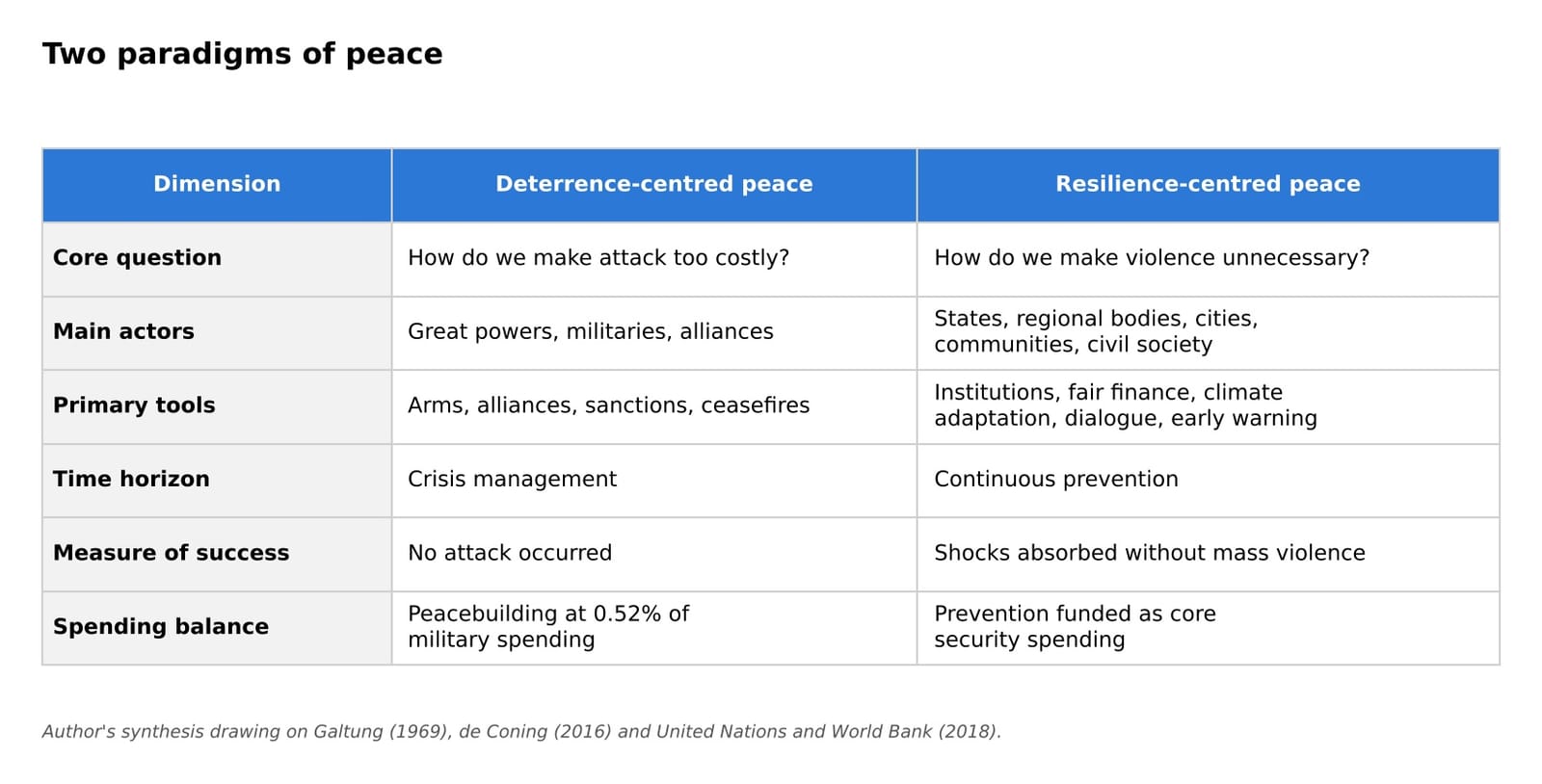
Resilience does not abolish deterrence. Rivals will still manage competition and states will still defend borders. Deterrence can buy time; only resilience can make that time count.
What peace actors should do differently
Moving from deterrence to resilience means changing money, mandates and mindsets at every level.
• The United Nations: from firefighter to resilience hub. The General Assembly now assesses US$50 million a year for the Peacebuilding Fund; that floor should rise in stages toward US$500 million. Peacekeeping should become smaller, faster and tied to a political strategy with clear exit benchmarks. Resolution 2719, which opens UN funding to African Union-led operations, should be used, not shelved. Members must clear their arrears, and permanent members should commit not to veto action on mass atrocities.
• The financial system: make fair access real. Countries forced to choose between creditors and citizens cannot sustain peace. We need a sovereign debt-workout mechanism, cheaper concessional finance and climate-resilient debt clauses that pause repayments after a major disaster. I propose a “1% for peace” pledge: states commit the equivalent of 1% of military budgets to prevention, peacebuilding and adaptation. At 2025 levels, that is about US$29 billion a year, more than five times the UN peacekeeping budget.
• Regional organisations: the first line of resilience. The AU, ECOWAS, IGAD, ASEAN, the OAS and the Pacific Islands Forum know local dynamics best. They should run early-warning systems linking climate, food-price and election data, and deploy mediators early. With New START gone, new arms-control talks should include China and cover missiles, cyber and autonomous weapons.
• National governments: build infrastructures for peace. Establish national peace councils, independent electoral bodies and local mediation networks, following Ghana, Kenya and Colombia. Security strategies should budget for climate adaptation, food security and youth jobs.
• Communities, women and youth: peace from the ground up. Resolutions 1325 and 2250 should mean decision-making roles, not consultation. Funding should reach community peace committees, faith leaders and cooperatives directly, with simpler reporting and longer time frames.
Finally, measure what matters. Alongside troops deployed and ceasefires signed, governments and donors should track interest versus health and education spending, early-warning coverage, trust in institutions and how fast communities recover from shocks.
The peace worth building
A world with 65 state-based conflicts, US$2.887 trillion in military spending, 82 million internally displaced people and 3.4 billion people in countries that spend more on interest than on health or education is not short of deterrence. It is short of resilience. Peacekeeping is being cut as conflicts peak, arms control is lapsing as new weapons spread, and aid is falling as debt and climate costs rise.
The alternative is neither naive nor new. It rests on long thinking about positive peace and hard evidence that prevention is cheaper than war. It asks the powerful to accept that their own security depends on whether a farmer in the Sahel, a factory worker in Dhaka or a graduate in Lima believes the system offers a fair chance.
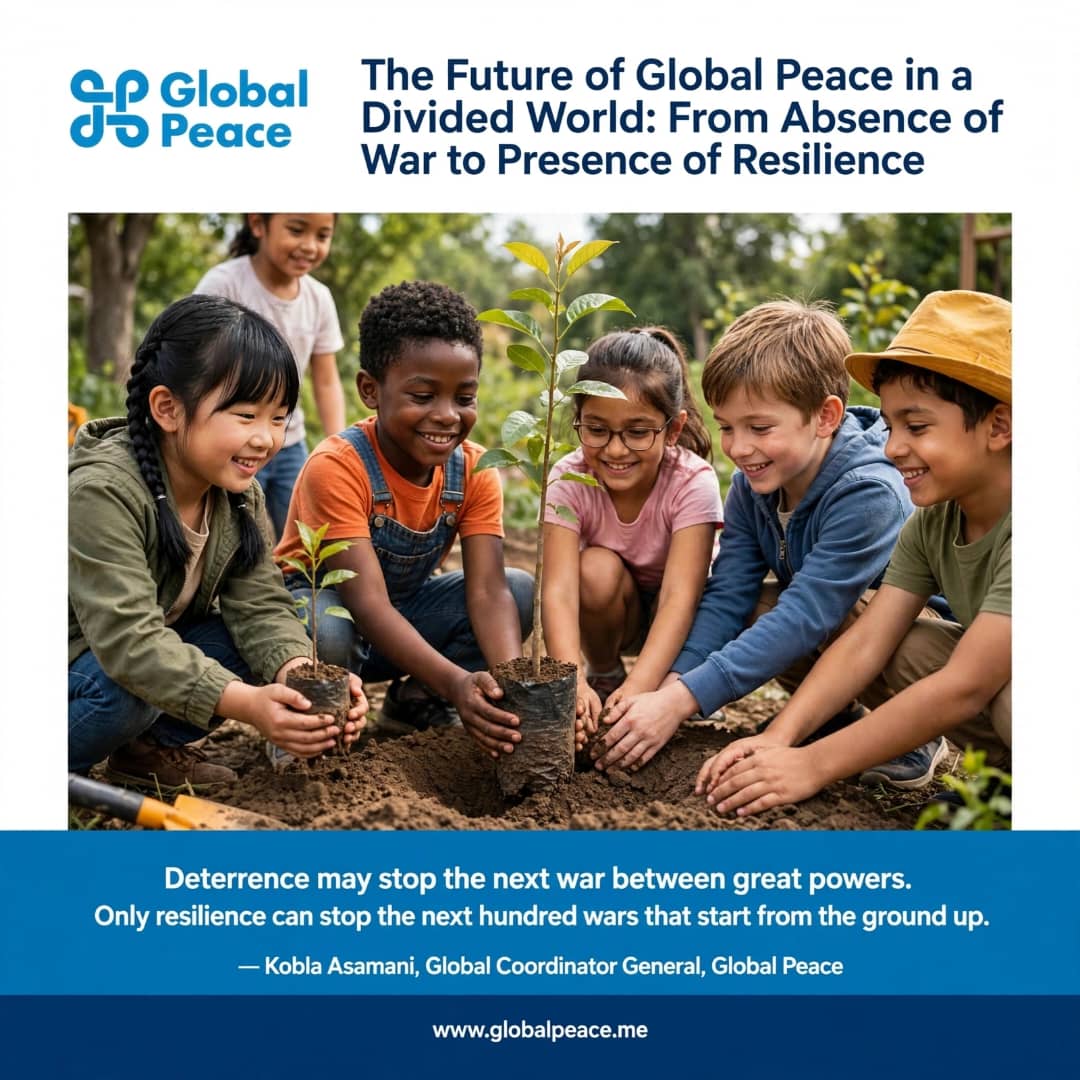
Deterrence may stop the next war between great powers. Only resilience can stop the next hundred wars that start from the ground up.
By Mawuli Kobla Asamani, Global Coordinator General, Global Peace; Coordinator of Campaign and Advocacy, ACCORD; PhD student in International Security and Intelligence, University of Professional Studies, Accra, Ghana.
Sources: Uppsala Conflict Data Program; SIPRI; Institute for Economics and Peace, Global Peace Index 2026; UNCTAD, A World of Debt 2025; OECD; Internal Displacement Monitoring Centre; UN News; Lowy Institute; Security Council Report; United Nations and World Bank, Pathways for Peace (2018).