On 5 October 2026, the world marks World Habitat Day under a theme that is both simple and revolutionary: Adequate Housing for All. The global observance will be held at the Oman Convention and Exhibition Centre in Muscat, Oman, hosted by the Government of Oman and UN-Habitat, marking the start of Urban October, a month of action that ends on World Cities Day, 31 October.
The theme is not accidental. It is urgent.
According to UN-Habitat’s World Cities Report 2026 and SDG 11 Global Report 2026, up to 3.4 billion people lack adequate housing worldwide. More than 1.1 billion people live in slums and informal settlements, an increase of over 130 million people since 2015. An estimated 2.8 billion people face some form of housing inadequacy: unaffordable, overcrowded, unsafe, or without basic services.
This is not a housing crisis in one region. It is a global crisis of dignity, security, and opportunity.
World Habitat Day was established by the UN General Assembly in 1985 through Resolution 40/202, first celebrated in Nairobi in 1986, and observed on the first Monday of October to reflect on the state of human settlements and the basic right of all to adequate shelter. In 2026, that right is under greater pressure than at any time in recent history.
In his message for the day, UN Secretary-General António Guterres called adequate housing “the foundation of dignity, security, and opportunity” and urged governments to treat housing as a public good, not a pure commodity or privilege.
UN-Habitat Executive Director Anacláudia Rossbach has been clear: the challenge is not only to build more houses, but to ensure that houses are adequate.

What does adequate mean? The UN defines it through seven criteria: security of tenure, availability of services, affordability, habitability, accessibility, location, and cultural adequacy. A house is not adequate if a family faces eviction every month. It is not adequate if it costs 80% of household income. It is not adequate if it is two hours from work, school, or a clinic, or if it floods every rainy season, or if persons with disabilities cannot enter it.
The 2026 concept note for Muscat builds on renewed political commitment. At the second session of the UN-Habitat Assembly in 2023, Member States adopted Resolution 2/7 on adequate housing for all and Resolution 2/2 on transforming informal settlements and slums. UN-Habitat launched the Open-ended Intergovernmental Expert Working Group on Adequate Housing for All, and 2026 is the first Urban October under its new Strategic Plan 2026-2029, which places housing, land and basic services at the centre of its mandate.
The numbers explain why. Globally, urbanisation continues at speed. By 2050, 70% of the world’s population will live in cities. Already, 1 in 4 urban residents lives in slum-like conditions. In Sub-Saharan Africa, that figure is over 50%. In South Asia, rapid growth of secondary cities without planning has created sprawl without services. In Latin America, housing deficits are driven less by lack of units than by unaffordability. In high-income countries, homelessness is rising again, driven by financialisation of housing, short-term rentals, and stagnant wages.
Climate change multiplies the risk. UN-Habitat estimates that 40% of slum dwellers live in areas highly exposed to climate hazards such as floodplains, coastal zones and steep slopes. A house without resilience is a house that will need to be rebuilt next year. Yet solutions exist, and World Habitat Day 2026 is designed to highlight them.

1. Policy: From Commodity to Right
Countries that have made progress treat housing as a right with public responsibility. Brazil’s Minha Casa Minha Vida, recognised in the 2026 Scroll of Honour, has delivered millions of units with social targeting. Tunisia’s upgrading of informal neighbourhoods shows how tenure regularisation unlocks family investment. The United Kingdom’s community land trust model, also a 2026 Scroll of Honour winner, removes land cost from housing cost, keeping it permanently affordable. Pakistan and Myanmar’s winners show how community-led incremental housing works after disasters. The lesson: subsidy alone is not enough. Secure land, clear tenure, and protection from speculation are essential.
2. Partnership: No Government Can Do It Alone
Oman’s hosting of the global observance is instructive. Its National Housing Strategy links housing to economic diversification, youth employment, and climate adaptation. Lagos State’s 2026 World Habitat Day event, themed “Adequate Housing for All,” called for affordability, infrastructure, and safe communities, not just buildings.
Effective models share three features: government enables land and finance, the private sector builds efficiently, and communities design and manage. Women-led savings groups, youth construction cooperatives, and slum dweller federations have built hundreds of thousands of units at lower cost because they eliminate profit-driven over-design.
3. Practical Solutions: Build Better, Build Where People Are
Three practical shifts matter most:
Firstly, upgrade in place. For 1.1 billion people, the fastest adequate housing is not relocation to the periphery, but upgrading where they already live: water, sanitation, electricity, drainage, paved access, and tenure security. UN-Habitat data shows in-situ upgrading costs 3 to 5 times less than new construction on new land.
Secondly, make housing climate-resilient from the start. Passive cooling, raised foundations, permeable surfaces, rainwater harvesting, and low-carbon materials cut both emissions and utility costs. Green cities are not a luxury; they are affordability.
Thirdly, unlock vacant and underused housing. Many cities have both homelessness and vacancy. Tools like vacancy taxes, conversion of commercial buildings, and rental assistance bridge that gap quickly.
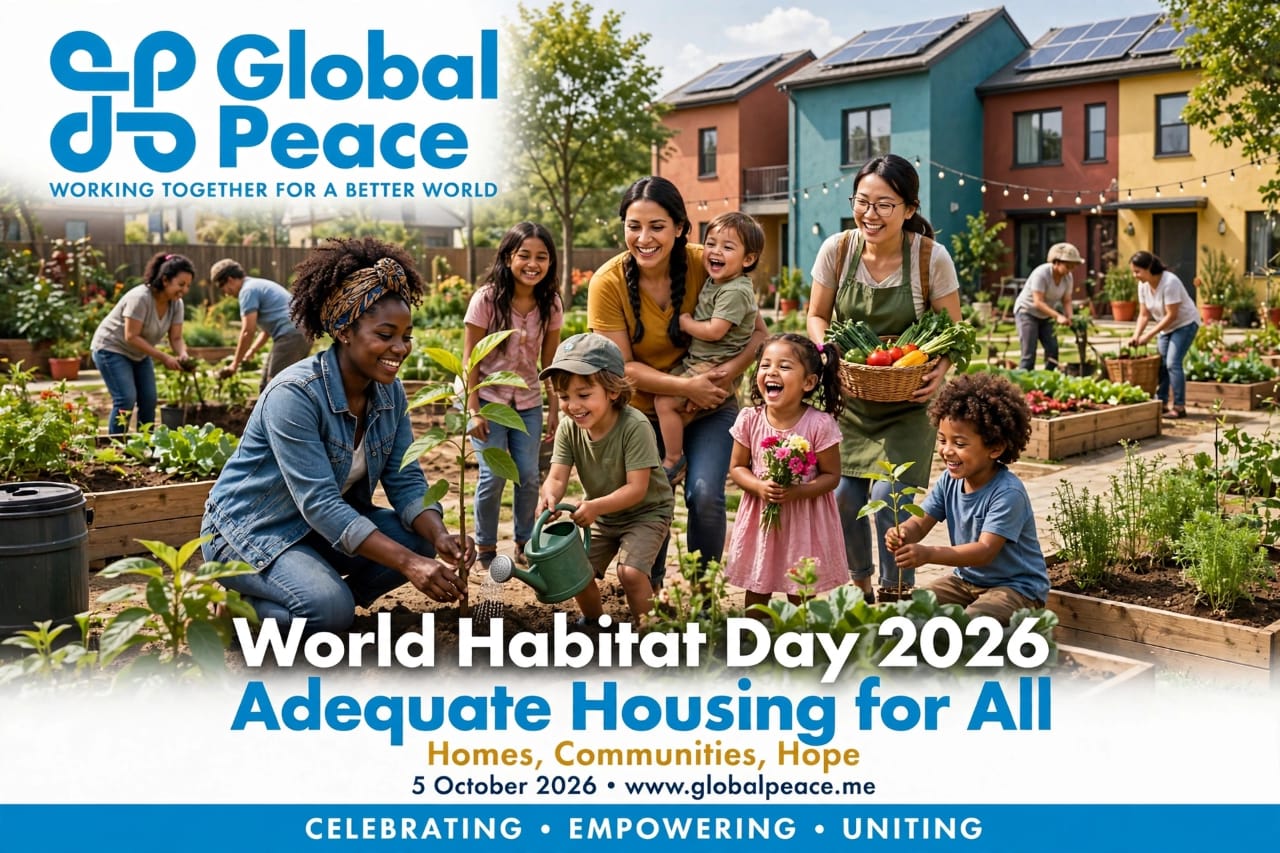
World Habitat Day also reminds us that adequate housing advances every other Sustainable Development Goal. Housing inadequacy drives health costs: respiratory illness from overcrowding, cholera from lack of sanitation. It drives education failure: children without light or space to study. It drives gender inequality: women and girls bear the burden of water collection and lack of privacy. It drives conflict: forced evictions are a leading cause of urban unrest. It drives economic informality: without an address, people cannot access finance or formal jobs.
The reverse is also true: investment in adequate housing pays. Analysis of housing investment suggests that $1 invested in slum upgrading saves $7 in health, disaster response, and policing costs. Tenure security alone increases household investment in housing by 30–50% within two years.
As we observe World Habitat Day 2026 in Muscat and in communities from Cameroon to India, Pakistan, Thailand, Sri Lanka, and beyond, the call is clear:
Adopt adequate housing as a national target with a budget. Measure not only units built, but affordability, location, and tenure security. Fund community-led upgrading. Reform land and finance systems so housing is a home first, not just an asset.
As the New Urban Agenda adopted in Quito in 2016 stated, adequate housing is the entry point to the right to the city. On 5 October 2026, we celebrate not just buildings, but belonging. A home is where dignity begins. Adequate Housing for All is not an aspiration. It is a foundation, and it is achievable.
Happy World Habitat Day 2026.
UN-Habitat, World Cities Report 2026 and SDG 11 Global Report 2026 — 3.4B / 1.1B figures.
UN Secretary-General António Guterres, World Habitat Day 2026 Message, 5 Oct 2026.
UN Committee on Economic, Social and Cultural Rights, General Comment No. 4: Right to Adequate Housing (1991).