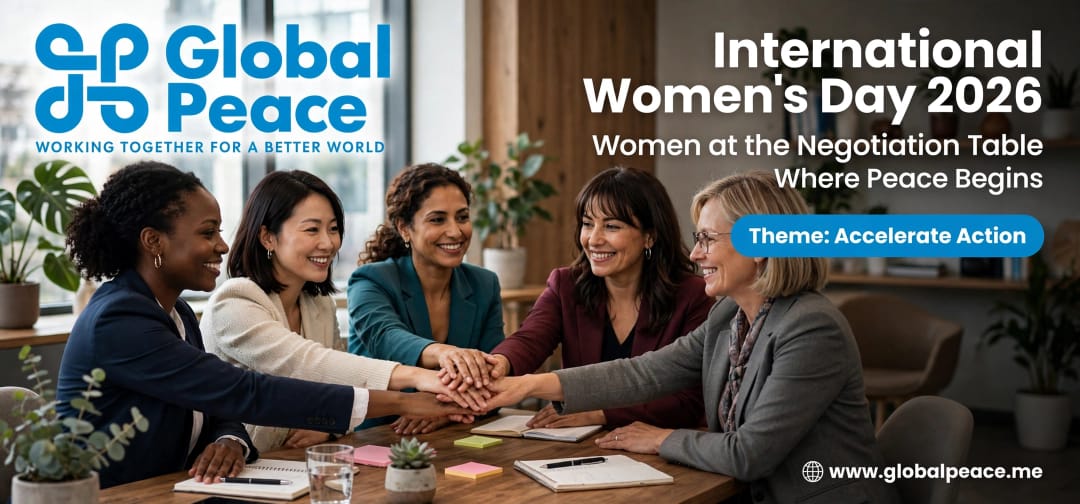
On 8 March 2026, International Women’s Day arrives at a moment of global reckoning. Military spending reached $2.44 trillion in 2023, the highest ever recorded. Yet the world experienced 56 active state-based conflicts, also the highest since 1946. More spending on war has not meant more peace. It has meant less.
The United Nations theme for 2026, Accelerate Action, is therefore not a slogan. It is a strategy. And the evidence points to one of the most powerful accelerators we have failed to use at scale: women at the negotiation table.
In 2000, the UN Security Council passed Resolution 1325 on Women, Peace and Security. Its message was simple and revolutionary: women are not only victims of war, they are architects of peace. Twenty-six years later, the data is unequivocal.
The Council on Foreign Relations finds that when women participate in peace processes as negotiators, mediators, or signatories, peace is 35% more likely to last at least 15 years. When women make up at least 30% of a negotiating team, an agreement is 64% less likely to fail. Research covering 300 peace agreements since 1990 shows that inclusion of women and civil society makes an accord 50% more likely to include provisions on political reform and development: the issues that address root causes, not just ceasefires.
Why does inclusion change outcomes? Because women tend to practise what peace research calls human security: security defined not only by borders and weapons, but by food, health, dignity, education, and displacement. They ask different questions. Not just “who controls territory?” but “who will feed displaced families? Who will get children back to school? How do we prevent the next cycle?” Those questions turn a ceasefire into positive peace.
From Northern Ireland to Colombia to Liberia to the Philippines, history proves this.
In Northern Ireland, the Women’s Coalition – Catholic and Protestant women who insisted on sitting at the Good Friday Agreement talks in 1998 – were the ones who pushed for integrated education, victim support, and mixed housing, not just prisoner release and power-sharing. Those provisions are why the agreement still holds.
In Colombia, women made up 33% of negotiators in the 2016 Havana Accords. The result: the agreement contains over 100 gender-specific provisions on land restitution, political participation, and protection from sexual violence, making it the most inclusive peace deal in modern history.
In Liberia, Leymah Gbowee and the Women of Liberia Mass Action for Peace sat daily at the fish market, blockaded peace talks in Accra in 2003 until mediators reached a deal, and forced warlords to stop negotiating who would get ministries and start negotiating how to stop rape as a weapon of war.
In the Philippines, Miriam Coronel-Ferrer became the first woman chief negotiator to sign a comprehensive peace accord in 2014 with the Moro Islamic Liberation Front. She ensured ancestral domain, women’s political participation, and economic inclusion were central, not afterthoughts.
Yet globally, we have not learned. Between 1992 and 2022, women made up only 6% of mediators, 6% of signatories, and 13% of negotiators in major peace processes tracked by UN Women. In 2023, only 12% of conflict-affected countries had women’s participation quotas that were funded. In 2024, women made up just 22% of parliamentarians worldwide. The gap between what we know works and what we do is the gap where peace fails.
And failure is expensive. Institute for Economics and Peace data shows $1 invested in peacebuilding and preventive diplomacy saves $16 in conflict response. Dialogue-based interventions cost $2,000 to $4,500 per life saved, while military interventions cost $850,000 to $1,000,000 per life saved: 425 times more. Prevention is not idealism. It is the cheapest, most effective security we have. And prevention that includes women is the cheapest of all.
This International Women’s Day, we call for three accelerations:
1. Budget Acceleration: From Weapons to Dialogue, With Women Leading
If countries reallocated just 5% of global military spending to preventive diplomacy and local peace infrastructure with mandatory 30% women’s participation, as required by UNSCR 1325 and Action 21 of the Pact for the Future adopted in September 2024, we would more than triple current spending on prevention. This would fund early warning systems, women mediator networks, and local peace councils that meet monthly, not just when crises erupt. This implements the call in paragraph 28 of the New Agenda for Peace (2023) for a prevention dividend. Security is not measured by what you spend on weapons. It is measured by whom you include at the table.
2. Infrastructure Acceleration: From Ad Hoc Talks to Permanent Inclusion
Peace cannot depend on being flown in after war breaks out. It needs permanent infrastructure where women lead. Rwanda’s Gacaca courts cost $52 million once, processed nearly 2 million cases with 35% women judges, and produced 20+ years of community reconciliation. The UN stabilisation mission in the Democratic Republic of Congo has cost about $1 billion a year for over two decades with no sustainable peace. Colombia’s 2016 agreement created a Gender Sub-Commission that still monitors implementation today. What gets institutionalised lasts.
3. Measurement Acceleration: Count Women, Not Just Soldiers
For decades we have measured security by counting tanks and troops. We must measure it by counting women at tables. Ask 10 simple questions: Is early warning acted on 6 months prior? Is 15% of the security budget for prevention? Are women 30% or more of negotiators? Youth 20% or more? Faith and traditional leaders included? Is there a continuous community dialogue mechanism? Is military budget reallocated to human security? Is human security tracked? Does the agreement address structural violence? Is there independent monitoring for 5 years? These are measurable commitments already made in Actions 20–23 of the Pact for the Future.
To every young woman reading this in Accra, Durban, Bogotá, Belfast, Manila, Kyiv, Gaza, Yangon, Port-au-Prince: The future will not be built in arms factories. It will be built at negotiation tables, in community circles, and in the daily practice of listening to the other. Your voice is not an add-on to security. Your voice IS security.
To our partners in governments, the UN, regional bodies, and mediation organisations: Adopt a 30% minimum for women in all peace teams. Publish prevention budgets. Fund women peacebuilder networks. Make inclusion a condition, not a suggestion.
On 8 March 2026, we celebrate not only women who endured war, but women who ended war. We celebrate the women of the White Helmets, the Syrian women’s advisory board who kept talks alive, the Ukrainian women documenting war crimes while running humanitarian corridors, the Sudanese women of the emergency response rooms feeding millions today.
As Desmond Tutu taught: “My humanity is bound up in yours.” There is no sustainable peace without women. There is no security without dialogue with women.
Happy International Women’s Day 2026.
CFR data: Council on Foreign Relations, “How Women’s Participation in Conflict Prevention and Resolution Advances U.S. Interests,” Discussion Paper, October 2016.
UN Women data: UN Women Executive Director statement, UN Security Council, 29 October 2020 – 1992–2019 data.
Military spending: SIPRI 2023 report ($2.44 trillion)