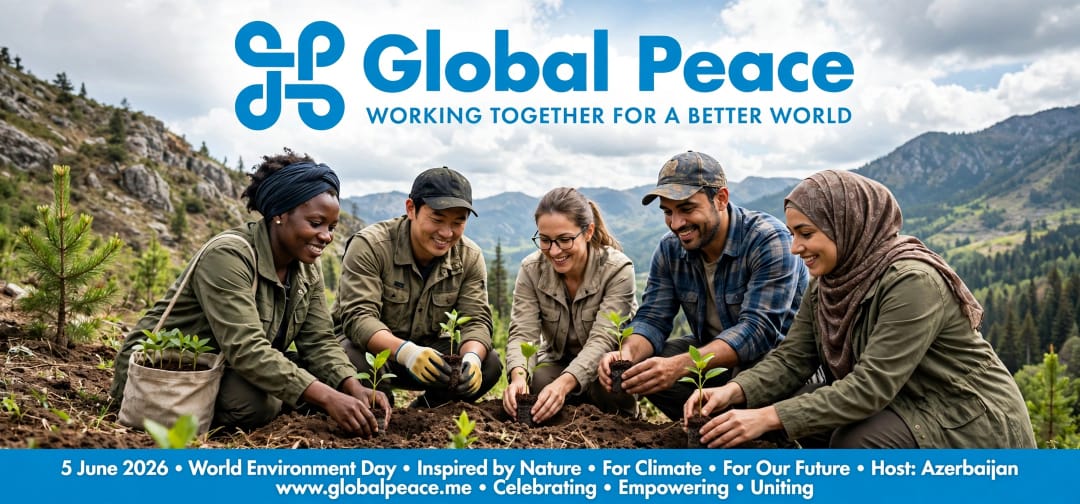
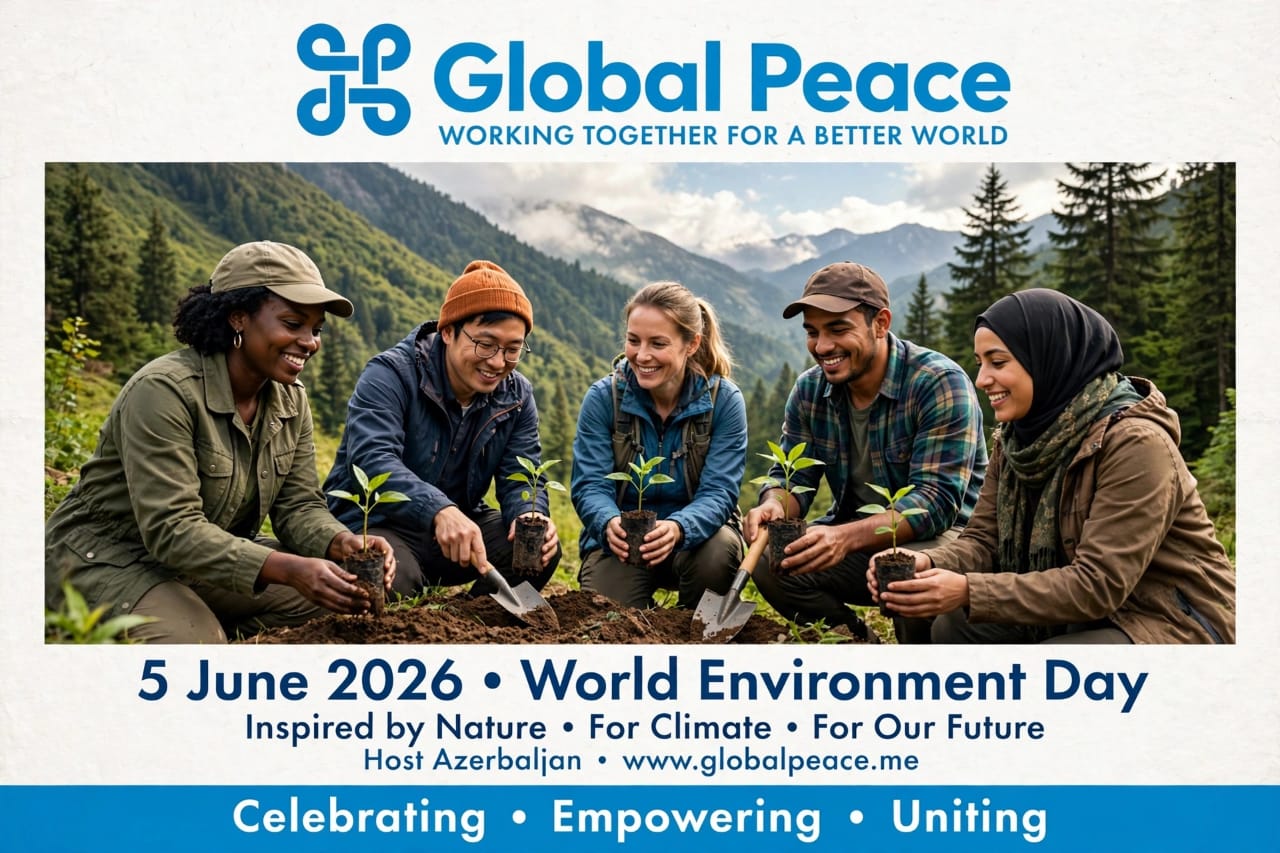
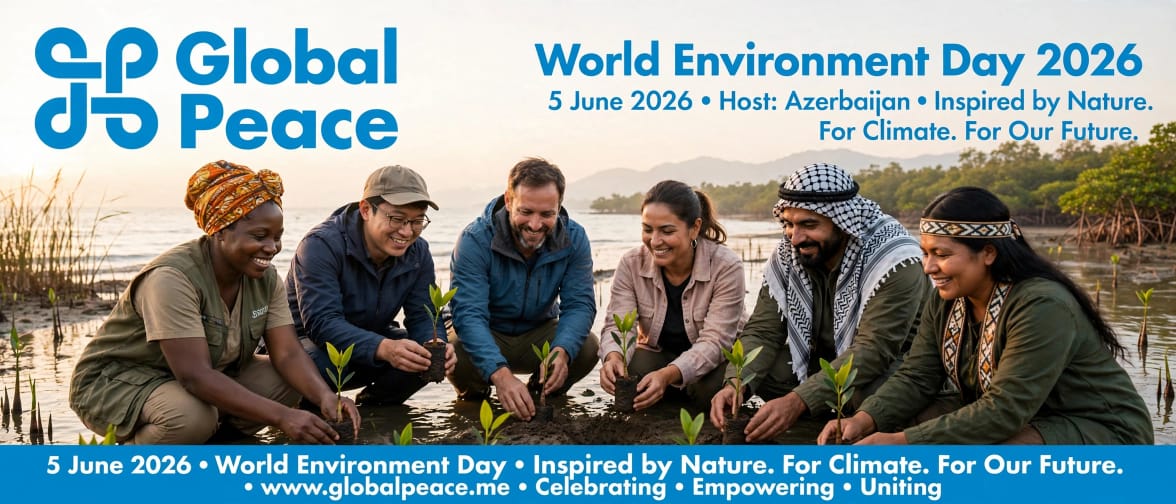
Every year on 5 June, the world marks World Environment Day, the United Nations’ flagship platform for environmental action, led by the United Nations Environment Programme (UNEP). This year, the global observance is hosted by the Republic of Azerbaijan in its capital, Baku, under the theme: “Inspired by Nature. For Climate. For Our Future.”
The choice of host is strategic. Having hosted UNFCCC COP29 in late 2024, Azerbaijan provides continuity to the global climate agenda. World Environment Day was first celebrated in 1973 and is observed in over 150 countries. In 2026, it carries a singular, urgent message that UNEP summarises powerfully: 2026 is about the urgent signals the Earth is sending, and the signals we choose to send back.
The numbers tell us what those signals are
According to UNEP and the World Meteorological Organization, the last 10 years were the hottest on record. Global average temperature in 2025 reached 1.48°C above pre-industrial levels. The rate of sea-level rise has doubled since 1993. In 2025 alone, climate-related disasters caused $310 billion in economic losses and displaced 32 million people. Yet, despite these signals, nature, our greatest ally, remains our most underfunded climate solution.

This is the paradox World Environment Day 2026 aims to break.
What Does Inspired by Nature Mean? Inspired by Nature means that climate action cannot be only about reducing emissions from factories and cars. It must be about restoring what reduces emissions for us, for free.
Nature-based Solutions (NbS) can provide up to 37 percent of the mitigation needed by 2030 to keep the 1.5°C target alive, according to the UNEP Emissions Gap Report 2025. Mangroves sequester four times more carbon than tropical forests per hectare. Peatlands store twice as much carbon as all the world’s forests combined, despite covering only 3 percent of land. Restoring 30 percent of degraded ecosystems as promised in the Kunming-Montreal Global Biodiversity Framework could avoid 50 percent of the emissions needed to stay below 2°C.
And nature is adaptation. In Azerbaijan, the host country, the Caspian Sea has fallen by 1.5 metres in the last 20 years due to climate change, threatening wetlands that host 10 million migratory birds annually. In response, Azerbaijan has committed to reduce greenhouse gas emissions by 40 percent by 2035, restore 200,000 hectares of degraded land in the Karabakh and Eastern Zangezur regions, and expand its marine protected areas in the Caspian, all to be showcased on 5 June in Baku.
Azerbaijan’s own story is instructive: a hydrocarbon economy seeking a green transition. For 2026, it launched the national campaign #NowForClimate, linking World Environment Day to its Green Growth Strategy.
Why Climate Focus in 2026? Three crises are colliding – climate change, biodiversity loss and pollution – in what UN Secretary-General António Guterres calls the Triple Planetary Crisis.
They are not separate. They are one crisis with three faces. Climate change drives biodiversity loss: coral bleaching has destroyed 50 percent of the Great Barrier Reef since 1995. Biodiversity loss drives climate change: deforestation contributes 11 percent of global emissions. Pollution drives both: black carbon accelerates glacier melt, and plastic in oceans reduces their capacity to absorb CO2 by 20 percent.
World Environment Day 2026 says: solve them together, through nature. What does that look like in practice?
1. Policy: From Extraction to Restoration
Countries that have made progress treat nature as infrastructure, not luxury.
Pakistan’s Ten Billion Tree Tsunami, recognised as a World Restoration Flagship, has restored 1.2 million hectares and created 85,000 green jobs for women and youth. In Brazil, deforestation in the Amazon fell by 50 percent in 2024–2025 after enforcement of indigenous land rights, proving that protecting those who protect forests works.
In Africa, the Great Green Wall initiative, stretching 8,000 km from Senegal to Djibouti, has restored 20 million hectares of degraded savanna, sequestering 250 million tons of CO2 while feeding 20 million people.
The lesson from UNEP: Every $1 invested in ecosystem restoration returns $7 to $30 in economic benefits in agriculture, fisheries, tourism, and disaster prevention.
Azerbaijan’s hosting brings focus to mountains and seas, two ecosystems often forgotten in climate talks. Mountain glaciers provide water to 2 billion people; the Caspian, the world’s largest inland sea, supports 15 million livelihoods.

2. Practical Solutions: What Nature Does for Climate
Four nature-based shifts matter most for 2026:
First, restore forests, not just plant trees. Natural regeneration, where forests regrow from stumps and seeds, stores 40 times more carbon than monoculture plantations, and costs 10 times less. Letting forests be forests is climate action.
Second, protect blue carbon. Mangroves, seagrasses, and salt marshes cover less than 2 percent of ocean area but store 50 percent of carbon buried in ocean sediments. Indonesia’s restoration of 600,000 hectares of mangroves is expected to sequester 2.5 gigatons of CO2 by 2035.
Third, regenerate soils. Regenerative agriculture – cover crops, compost, reduced tillage – can sequester 1.2 tons of carbon per hectare per year, while increasing yields by 15–25 percent. Healthy soil is a carbon bank.
Fourth, green cities. Nature in cities – trees, parks, wetlands – reduces urban temperatures by up to 5°C, cuts flood risk by 30 percent, and improves mental health. UN-Habitat data shows that cities with 30 percent green cover have 25 percent lower heat-related mortality.
3. People: The Future is Local and Female
The theme “For Our Future” is deliberate. The future is not abstract. It is the youth.
70 percent of youth climate activists globally are female. In Ghana, where ABANTU for Development has worked for 27 years at the intersection of gender and environment, women produce 70 percent of food but own 10 percent of land. When women have secure land tenure, farm productivity increases by 20–30 percent, and deforestation drops by 30 percent.
World Environment Day 2026 therefore calls for gender-responsive climate finance. Currently, only 2 percent of climate finance reaches women-led organisations. Changing that is climate action.
To every student, farmer, fisher, pastoralist, entrepreneur reading this in Accra, Baku, Delhi, Nairobi, Bogotá: The future will not be built only in Baku conference halls. It will be built in the mangrove you replant, the soil you compost, the roof you paint white, the bus you choose, and the product you refuse because it came from deforested land.
To governments and business: Adopt nature-based targets alongside net-zero targets. Publish nature-related financial disclosures. End subsidies that destroy nature: $7 trillion in fossil fuel, agriculture, and fishery subsidies that harm the environment were paid in 2023. Redirect them.
As UNEP Executive Director Inger Andersen said for World Environment Day 2026: “Nature is not optional. It is central to climate resilience and our collective future. The Earth is sending signals. Nature shows us how to answer.”
On 5 June 2026, from Baku to every village and city, we celebrate not just the environment, but our dependence on it, and our ability to restore it.
Because climate action without nature is a spreadsheet. Climate action with nature is a future. Inspired by Nature. For Climate. For Our Future is not a slogan. It is a survival plan, and it is achievable. Happy World Environment Day 2026.
UNEP, World Environment Day 2026 Theme and Host “Inspired by Nature. For Climate. For Our Future” Host: Republic of Azerbaijan, Baku; 5 June 2026, worldenvironmentday.global
UNEP, “World Environment Day 2026 focuses on climate change on the urgent signals the Earth is sending and the signals we choose to send back” official campaign text.
Azerbaijan national campaign “nature is not optional it is central to climate resilience and our collective future.”